Our system will evaluate the answer based on this AI-generated description.
The image presents a bar chart depicting the number of jobs in tourism-related industries in a UK city from 1989 to 2009, with separate bars for restaurants, hotels, sport and leisure, and travel and tours for each year. The chart records figures for the years 1989, 1994, 1999, 2004, and 2009. The values for 1989 are as follows: restaurants with approximately 700 jobs, hotels with about 500, sports and leisure with roughly 200, and travel and tours with slightly over 100 jobs. In 1994, the job numbers increase in all sectors with restaurants at approximately 800, hotels around 600, sport and leisure at nearly 500, and travel and tours just above 300. 1999 sees a further rise: restaurants surpassing 900, hotels around 850, sport and leisure close to 750, and travel and tours at 500. In 2004, there is a mixed trend with restaurants reaching almost 1700, hotels over 700, sport and leisure around 850, but travel and tours declines to approximately 400. The final year, 2009, shows a decrease across all industries except for travel and tours which recover to around 600 jobs, while restaurants drop to just over 1400, hotels to 750, and sport and leisure to roughly 550. All trends are illustrated by multiple bars on the y-axis, rising from zero to a maximum of 1800 jobs, with each bar corresponding to a respective industry in the tourism sector.
Given the complexity of the image, the above description may not be entirely accurate.
Skyrocket your IELTS band score by 1-2 points in under a month with our premium plan!
Note: Both the topic and the answer were created by one of our users.
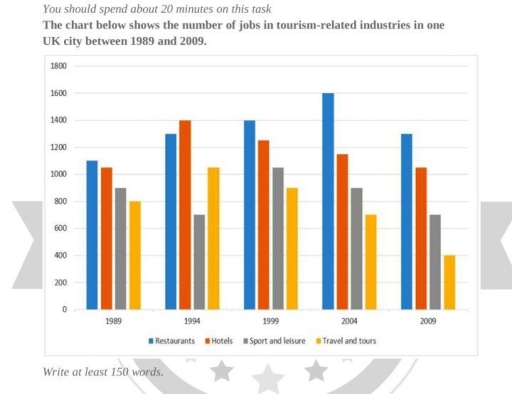
The given bar chart compares the number of jobs in tourism-related industries in a particular city in UK from 1989 to 2009.
In general, Uk consistently had the highest number of restaurants, except in 1994, whereas the opposite case was true for travel tours, which recorded lowest number of jobs, with the exception of 1994. Notably, UK recorded an increasing trajectory in the number of restaurants, overtaking other industries. In contrast, travel&tours and sport&leisure followed the opposite pattern.
Looking at more in detail, in 1989, the number of restaurants stood at approximately 1,110, followed by hotels at just over 1,000, sport leisure at nearly 900 and travel&tours at 800. By 1999, the figure for restaurants rose to 1,400, surpassing hotels, sport leisure and travel tours, which each accounted for less than 1,300.
From 1999 onwards, the number of restaurants continued to increase, reaching a peak of 1600 in 2004, before dropping to nearly 1,300 in the final year. By contrast, by 2009, a prolonged decrease can be seen in the numbers of hotels, sport leisure and travel tours, with the respective figures of 1,250, 700 and 400.
Word Count: 187
