🔥 Today Only: Save 30% on Premium — Offer Ends Soon! - Upgrade Now!
Line Graph

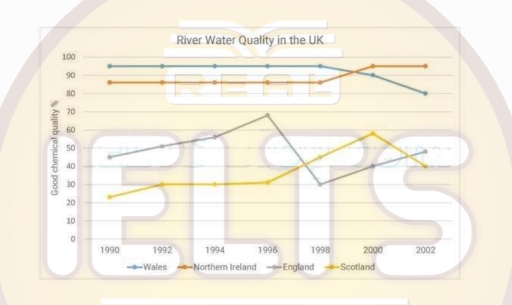
Band 4+: The chart below shows the percentage of river water in UK rivers that is classified as having good chemical quality between 1990 and 2002.

Image for topic: The chart below shows the percentage of river water in UK rivers that is classified as having good chemical quality between 1990 and 2002.
Our system will evaluate the answer based on this AI-generated description.
The image displays a line graph titled "River Water Quality in the UK" tracking data from 1990 to 2002 for Wales, Northern Ireland, England, and Scotland. The y-axis ranges from 0 to 100%, marked at intervals of 10, and represents "Good chemical quality %". Data for each region shows: Wales starting near 95% in 1990, peaking just below 100% around 1994, dipping slightly in 1996, and stabilizing near 95% in 2002. Northern Ireland begins around 60% in 1990, shows a sharp improvement to nearly 90% by 1994, sees a sharp drop back to 60% in 1996, recovers to around 90% by 1998 and 2000, dropping sharply again by 2002. England starts just above 70% in 1990, dips slightly below during the mid-90s, and climbs back to just above 70% by 2002. Scotland begins just under 90% in 1990, experiences a gradual decrease to about 80% by 2002. The graph uses distinct line styles for each region, plotted on a horizontally-oriented rectangular plot area with a grid.
Given the complexity of the image, the above description may not be entirely accurate.
Note: Both the topic and the answer were created by one of our users.

The chart illustrates the proportion of water in UK rivers that met the standards for good chemical quality from 1990 to 2002.

Overall, Wales accounted for the highest figures, while Scotland had the lowest percentages. England showed fluctuations, whereas Northern Ireland experienced a slight increase at the end of the period.

In 1992, Scotland showed an increase, reaching 30% of water, whereas England demonstrated a slight increase, reaching 50%. In contrast, Northern Ireland and Wales remained stable. From 1992 to 1996, Scotland remained stable at 30%, while England continued to rise, reaching 70%. Between 1996 and 1998, England faced a dramatic decline from 70% to 30%, meanwhile, Scotland continued to rise from 30% to above 40%. In addition, in 2000, Scotland reached a peak of 60%. From 2000 to 2002, England continued to rise after a decline, reaching under 50%, whereas Scotland faced a sharp decline from 60% to 40%.

In contrast, from 1990 to 1996, both Wales and Northern Ireland remained stable. From 1998 to 2000 Northern Ireland showed an increase rising from above 80% to over 90%, during that period Wales decreased from under 100% to 90%.

From 2000 to 2002, Wales continued to decline from 90% to 80%, however, Northern Ireland remained stable.

Word Count: 206

Answers On The Same Topic:

The chart below shows the percentage of river water in UK rivers that is classified as having good chemical quality between 1990 and 2002.

The graph shows the information about the water which was arranged by the quality of having good substances in UK rivers from 1990 to 2002. Overall, The Northern Ireland and Scotland saw rising trends over the period, while the opposite trend is good for Wales. Furthermore, England fell in the middle but then recovered at […]

The chart below shows the percentage of river water in UK rivers that is classified as having good chemical quality between 1990 and 2002.

The line graph gives information about the proportion of river water quality in 4 parts of UK which was classified as having good chemical substances in it from 1990 and 2002. Overall,although Wales was dominated by 2000, however, its palce was overtaken by Northern Ireland after 2000.Moreover. Scotland was the city where did not have […]

The chart below shows the percentage of river water in UK rivers that is classified as having good chemical quality between 1990 and 2002.

The line graph illustrates the percentage of good chemical quality of rivers in UK between 1990 and 2002. Overall, in this picture an increase observed, except Wales. At the beginning of the year the biggest was Wales, and lowest was Scotland, and at the end of the year Northern Ireland increased to first place, but […]

The chart below shows the percentage of river water in UK rivers that is classified as having good chemical quality between 1990 and 2002.

The given line graph illustrates the percentage of river water in four different regions of England that is categorized as possessing excellent chemical quality across the year 1990 and 2002. Overall, the wales and Northern Ireland contained the higher amount of good chemical quality. However, England and Scotland initially rose but over time they went […]

See All

Other Topics:

The chart shows the percentage of people who accessed news from 4 sources from 1995 and projection to 2025.Summarize the information by selecting and reporting the main features, and make comparisons where relevant.

The line graph compares the percentages of individuals using four different sources to access news from 1995 and predictions to 2025. Overall, TV was the most used source until 2020 as the internet’s share is predicted to overtake its popularity by 2025, also experiencing the most substantial growth over the period. Additionally, the popularity of […]

The graph shows how elderly people in the United States spent their free time between 1980 and 2010.

The line graph illustartes how often individuals in the United States spent their free time from 1980 to 2010. Overall,it can be seen that,the most leading category was hiking while the theatre attendance figures turned out to be low. Initially,in 1980s reading rate demonstrate 30% and then it gradually increased to 40% until 1990s,however,between 1990s […]

The graph below gives information about car ownership in one European country from 1975 to 2005.

The line graph illustrates data about changes in car ownership divided in four categories namely, no car, 1 car, 2 cars and 3 cars in one European country over a thirty-year period between 1975 and 2005. Overall, most figures followed upward trends and remained stable throughout the period, with the exception of no car it […]

The graph below shows the number of passengers using four types of public transport in a European city between 2000 and 2025. Summarise the information by selecting and reporting the main features, and make comparisons where relevant.

The line graph compares the number of passengers using four types of public vehicle in a European city from 2000 to 2025. Overall, the metro accounted for the largest use of transport, while bicycle-sharing were lowest using transport, however in the end of the period bicycle and tram overtook the bus, which the first 3 […]

The graph below shows the number of passengers using four types of public transport in a European city between 2000 and 2025. Summarise the information by selecting and reporting the main features, and make comparisons where relevant.

The line graph compares the number of passengers using Bus, Metro, Tram, Bicycle-sharing in an European city between 2000 and 2025. Overall, Metro was the most popular transport in most years, while tram and bicycle-sharing grew constantly and overtook Bus by the end of the period. By contrast, buses followed a download pattern and finished […]

The chart below shows the percentage of households with different kinds of technology in the UK from 1997 to 2001. Summarise the information by selecting and reporting the main features, and make comparisons where relevant.

The line graph compares the percentage of households in the UK that owned five different types of technologies, namely CD player, telephones , computers, the internet and DVD players, between 1997 and 2001, at 1-year intervals. Overall, the proportion of households in the UK that owned three different types of technology- telephones, the Internet and […]

See All
We have detected unusual activity on your device.
Please verify your identity to continue.
Note: This verification step won't sign you in. If you have a premium account, please log in to access the service as usual.
Google/Gmail Verification
Or verify using Email/Code
We've sent a verification code to:
youremail@gmail.com (Not your email?)
Enter it below to complete the verification process.
Ensure your email address is correct, your inbox is not full, and you check your spam folder. If no email arrives, consider using an alternative email.
You will need a Premium plan to perform your action!
Note: If you already have a premium account, please log in to access our services as usual.

Plans & Pricing

Our mission is to make quality education accessible for everyone.
However, to keep our hardworking team running and this service alive, we genuinely need your support!
By opting for a premium plan, not only do you sustain us in achieving the mission, but you also unlock advanced features to enrich your learning experience.

Free

For learners who aren't pressed for time

What's included on Free
100+ Cambridge IELTS Tests
Instant IELTS Writing Task 1 & 2 Evaluation (2 times/month)
Instant IELTS Speaking Part 1, 2, & 3 Evaluation (2 times/month)
Instant IELTS Writing Task 1 & 2 Essay Generator (2 times/month)
500+ Dictation & Shadowing Exercises
100+ Pronunciation Exercises
Flashcards
Other Advanced Tools

Premium

For those serious about advancing their English proficiency, and for IELTS candidates aspiring to boost their band score by 1-2 points (especially in writing & speaking) in just 30 days or less

What's included on Premium
Save Your IELTS Test Progress & Analyze Mistakes By Question Type
Save Your Own Flashcard Sets & Use Them On Any Device
Unlock All Courses, IELTS Tests, Section & Part Practice
Unlimited AI Conversations
Unlimited AI Writing Enhancement Exercises
Unlimited IELTS Writing Task 1 & 2 Evaluation
Unlimited IELTS Speaking Part 1, 2, & 3 Evaluation
Checked Answers Will Not Be Published
Unlimited IELTS Writing Task 1 & 2 Essay Generator
Unlimited IELTS Speaking Part 1, 2, & 3 Sample Generator
Unlimited Usage Of Advanced Tools & AI Features
Priority Support within 24h (12-month plan only)

Due to the nature of our service and the provided free trials, payments are non-refundable.