Our system will evaluate the answer based on this AI-generated description.
The image shows two graphs about education levels in Glasgow in 2010: a bar chart displaying education levels by age range and a pie chart showing education levels by gender. In the bar chart, for the 16-24 age range, 9% have a university degree, 71% have a school certificate, and 20% have no qualifications; for 24-35, 15% have a degree, 76% have a certificate, and 9% have no qualifications; for 35-50, 20% have a degree, 71% have a certificate, and 9% have no qualifications; for 50-75, 20% have a degree, 50% have a certificate, and 30% have no qualifications; for 75+, 3% have a degree, 25% have a certificate, and 72% have no qualifications. In the pie chart, for women, 38% have a degree, 29% have a certificate, and 33% have no qualifications, while for men, 35% have a degree, 32% have a certificate, and 33% have no qualifications.
Given the complexity of the image, the above description may not be entirely accurate.
Skyrocket your IELTS band score by 1-2 points in under a month with our premium plan!
Note: Both the topic and the answer were created by one of our users.
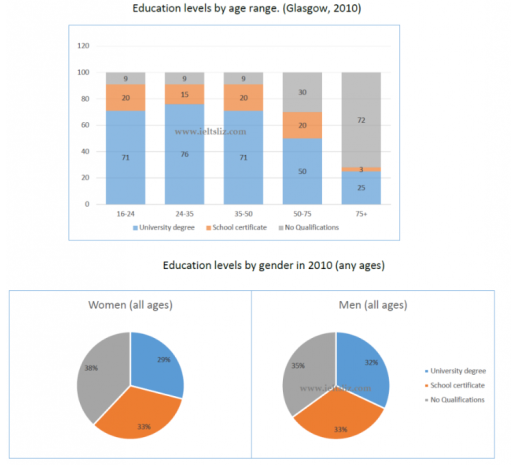
The bar chart and pie charts illustrate the percentage of people in Glasgow having three levels of education (university, school and those with no qualifications) in 2010. Information is divided into five age groups in the bar chart and by gender in the pie charts.
Overall, the majority of people with university education were in younger age groups, while in the oldest age group most people did not have any qualifications. The proportions of men and women were similar and showed little different between the levels of education.
The percentage of people with university education was up to 76% in the younger three age groups compared to only 50% in those ages 50 to 75 and just 25% in those over 75. This trend was reversed in those with no qualifications (9% in younger people rising to 72% in the oldest age group). The figure for those with school education was relatively constant at around 20% but was as low as 3% in the over 75’s.
The proportion of men and women in each level of education was around one third with only a slightly difference of 3% in university graduates as well as those who didn’t have educational qualifications.
Word Count: 200
