Our system will evaluate the answer based on this AI-generated description.
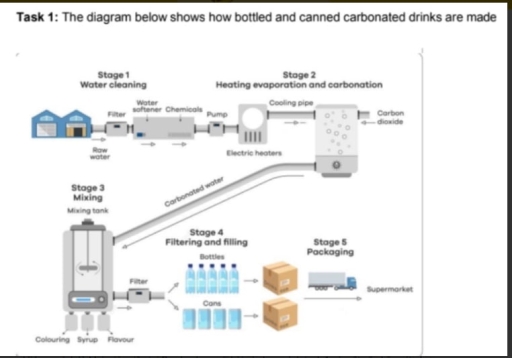
The image displays a five-stage process diagram of how bottled and canned carbonated drinks are made. Stage 1, titled "Water cleaning," includes a flow depicting raw water undergoing filtration, water softening through chemicals, and pumping. Stage 2, "Heating evaporation and carbonation," shows cooling pipes and electric heaters connected to a carbon dioxide source, indicating carbonation. Stage 3, labeled "Mixing," features a mixing tank where coloring, syrup, and flavor are added to the carbonated water. Stage 4, named "Filtering and Filling," illustrates filtered liquid being filled into bottles and cans. The final Stage 5, "Packaging," portrays the bottled and canned drinks being boxed and subsequently transported to a supermarket. Each stage is interlinked with arrows, emphasizing the progression of the production process.
Given the complexity of the image, the above description may not be entirely accurate.
Skyrocket your IELTS band score by 1-2 points in under a month with our premium plan!
Note: Both the topic and the answer were created by one of our users.
The diagram illustrates the process involved in the production of bottled and canned carbonated drinks.
Overall, it is clear that the process consists of five main stages, beginning with the cleaning of water and ending with the packaging of drinks. It is also worth mentioning that it is a linear, man-made process that requires both labor-intensive and machine-driven jobs, with the latter taking up the most of the work.
At the initial stage of the process, raw water undergoes a sequence of treatments, including filtration, the addition of softeners and chemicals, and pumping to the next unit. At the second stage, after being heated in electric heaters, raw water passes through a cooling pipe where its temperature is reduced, preparing it for the addition of carbon dioxide. Following this, carbonated water flows into a mixing tank where it is treated with coloring, syrup, and flavour, marking the third stage. After undergoing treatment, it passes through filtration before being filled into plastic bottles and cans. In the final stage, the finished goods are packaged in boxes and transported to supermarkets for distribution.
Word Count: 181
