🔥 Today Only: Save 30% on Premium — Offer Ends Soon! - Upgrade Now!
Line Graph

Band 7+: The graph below gives information about three different ways of communication used by teenagers in the United States between 1990 and 2020

Image for topic: The graph below gives information about three different ways of communication used by teenagers in the United States between 1990 and 2020
Our system will evaluate the answer based on this AI-generated description.
The image presents a line graph depicting three different communication methods used by teenagers in the United States from 1990 to 2020, represented by text messages, calls, and face-to-face. In 1990, text messages start at approximately 0%, calls at about 70%, and face-to-face at 90%. By 2000, text messages rise to around 15%, calls decline to roughly 75%, and face-to-face drops to about 80%. In 2010, text messages increase to approximately 40%, calls continue to decrease to around 50%, and face-to-face falls to about 60%. In 2020, text messages surge to 80%, calls further decrease to around 30%, and face-to-face plummets to about 40%. Each communication method's line intersects with the others at different points between 2000 and 2010, with text messages and calls intersecting at around 2005 near 40%, and text messages and face-to-face intersecting close to 2010 at nearly 50%.
Given the complexity of the image, the above description may not be entirely accurate.
Note: Both the topic and the answer were created by one of our users.

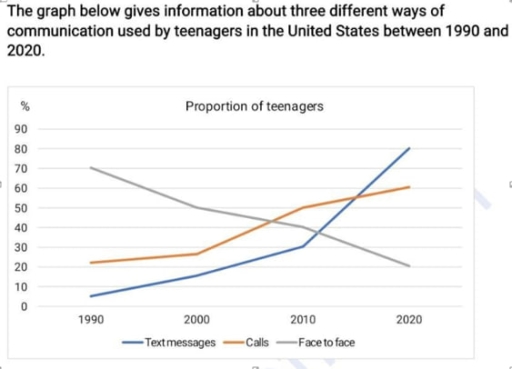
The line graph compares the proportion of teenagers in the United States who used three different types of communication – face-to-face interaction, text messaging, and phone calls – between 1990 and 2020.

Overall, the rate of face-to-face communication among teenagers declined dramatically over the period, while both text messaging and phone communication increased substantially.

Looking at the data in more detail, in-person communication was by far the most common form in 1990, accounting for around 70% of all teenage interactions. However, this figure fell sharply to 50% by 2000 and continued to decline steadily, reaching a record low of 20% by 2020.

In contrast, communication through text messages rose consistently throughout the period. Starting at just 5% in 1990, it grew steadily to 30% by 2010 and reached an all-time high of 50% by 2020, reflecting a clear shift towards digital communication.

Similarly, the share of phone-based communication followed an upward trend. It began at just over 20% in 1990, climbed gradually to about 30% by 2000, and then surged to 60% by the end of the period, showing teenagers’ growing reliance on mobile phones for interaction.

Word Count: 187

Answers On The Same Topic:

The graph below gives information about three different ways of communication used by teenagers in the United States between 1990 and 2020

The line graph delineates the evolution of three distinct modes of communication employed by adolescents in the United States from 1990 to 2020. Overall, there is a marked increase in text messaging as a preferred communication method among teenagers, while both calls and face-to-face interactions exhibit a significant decline over the specified period. In 1990, […]

The graph below gives information about three different ways of communication used by teenagers in the United States between 1990 and 2020

The line chart illustrates information about three various methods of conversation utilized by young people in United States from 1990 to 2020. Overall, at the beginning of the period, the figure for face to face interaction was highest figure among other figures, whereas text messages recorded the lowest figure at the starting point. Nevertheless, over […]

The graph below gives information about three different ways of communication used by teenagers in the United States between 1990 and 2020

The line graph illustrates the percentage of American teenagers who used three methods of communication from 1990 to 2020, over a period of 30 years. Looking from an overall perspective, it can be seen that the figure for those who utilized face-to-face communication witnessed a downward trend, while conversation which are texting and calling went […]

The graph below gives information about three different ways of communication used by teenagers in the United States between 1990 and 2020

The line graph compares the percentage of teenagers who was used three types of communication skills in the US from 1990 and 2020. Overall, the rate of face to face communication used by teenagers experienced a fall whereas the figures for the remaining categories increased sharply, throughout the span covered. Looking at the graph in […]

See All

Other Topics:

The line graph shows the percentage of people who used three different types of transport (car, bus, and bicycle) to travel to work in a city between 2000 and 2020.

This line chart depicts the proportion of individuals using three modes of commute to travel to work in a city across 20 years. In a glimpse, car usage was significantly higher then that of buses and bicycles across the timeframe, just as cycling recorded the lowest figures. From 2000 to 2020, the ranking of all […]

The graph below gives information about the number of jobs in four sectors of the economy in the US between 1960 and 2020. Summarise the information by selecting and reporting the main features, and make comparisons where relevant.

The line graph illustrates changes in the number of jobs available in four different sectors of the US, which include manufacturing, retail, agriculture, and healthcare, over the period from 1960 to 2020. Overall, it is evident that manufacturing experienced an initial increase before following a downward trend, whereas retail and healthcare followed upward trends. In […]

The graph below shows the price of different kinds of bread in dollars from 2001 to 2005. Compare the trends and write a report.

The line chart provides key information about the cost of five different types of bread in dollars during the period from 2001 to 2005. Overall, it is clear from the graph that wholegrain bread at the beginning of the period got a lower price. However, in the middle of the period the price increased significantly […]

The line graph gives information about the number of Iranian, Greek and Turkish students who enrolled at Sheffield University between 2005 and 2009. Summarize the information by selecting and reporting the main features, and make comparision where relevant.

The line graph illustrates the number of international students from three countries, Iran, Greece and Turkey, who registered at Sheffield University between 2005 and 2009. Overall, it is clear that the number of Greek students decreased significantly throughout the period, while the figures for Iranian and Turkish students increased substantially. In 2005, Greece had the […]

The line graph gives information about the number of Iranian, Greek and Turkish students who enrolled at Sheffield University between 2005 and 2009. Summarize the information by selecting and reporting the main features, and make comparision where relevant.

The line graph illustrates the number of international students from three countries, Iran, Greece and Turkey, who registered at Sheffield University between 2005 and 2009. Overall, it is clear that the number of Greek students decreased significantly throughout the period, while the figures for Iranian and Turkish students increased substantially. In 2005, Greece had the […]

The graph below shows the percentage of people in a European country, by age group, who believed that wearing traditional attire was an important part of their cultural identity between 1990 and 2020.

The line graph illustrates the percentage of people lived in Europe, by five age groups who had a belief that wearing traditional attire had a significant meaning of their cultural identification between 1990 and 2020. Overall, age grops that are older showed higher percentage but gradually declined decade by decade. As for the younger generation […]

See All
We have detected unusual activity on your device.
Please verify your identity to continue.
Note: This verification step won't sign you in. If you have a premium account, please log in to access the service as usual.
Google/Gmail Verification
Or verify using Email/Code
We've sent a verification code to:
youremail@gmail.com (Not your email?)
Enter it below to complete the verification process.
Ensure your email address is correct, your inbox is not full, and you check your spam folder. If no email arrives, consider using an alternative email.
You will need a Premium plan to perform your action!
Note: If you already have a premium account, please log in to access our services as usual.

Plans & Pricing

Our mission is to make quality education accessible for everyone.
However, to keep our hardworking team running and this service alive, we genuinely need your support!
By opting for a premium plan, not only do you sustain us in achieving the mission, but you also unlock advanced features to enrich your learning experience.

Free

For learners who aren't pressed for time

What's included on Free
100+ Cambridge IELTS Tests
Instant IELTS Writing Task 1 & 2 Evaluation (2 times/month)
Instant IELTS Speaking Part 1, 2, & 3 Evaluation (2 times/month)
Instant IELTS Writing Task 1 & 2 Essay Generator (2 times/month)
500+ Dictation & Shadowing Exercises
100+ Pronunciation Exercises
Flashcards
Other Advanced Tools

Premium

For those serious about advancing their English proficiency, and for IELTS candidates aspiring to boost their band score by 1-2 points (especially in writing & speaking) in just 30 days or less

What's included on Premium
Save Your IELTS Test Progress & Analyze Mistakes By Question Type
Save Your Own Flashcard Sets & Use Them On Any Device
Unlock All Courses, IELTS Tests, Section & Part Practice
Unlimited AI Conversations
Unlimited AI Writing Enhancement Exercises
Unlimited IELTS Writing Task 1 & 2 Evaluation
Unlimited IELTS Speaking Part 1, 2, & 3 Evaluation
Checked Answers Will Not Be Published
Unlimited IELTS Writing Task 1 & 2 Essay Generator
Unlimited IELTS Speaking Part 1, 2, & 3 Sample Generator
Unlimited Usage Of Advanced Tools & AI Features
Priority Support within 24h (12-month plan only)

Due to the nature of our service and the provided free trials, payments are non-refundable.