Our system will evaluate the answer based on this AI-generated description.
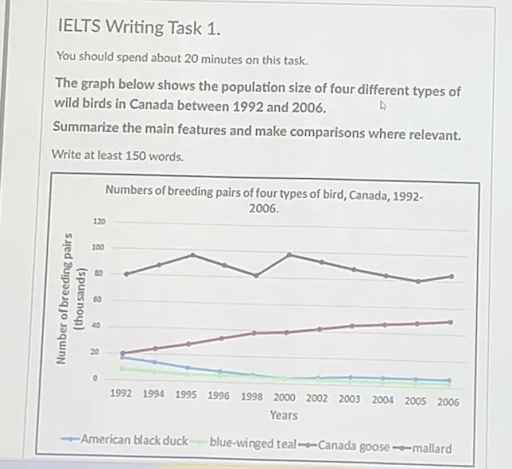
The image illustrates the population size of breeding pairs of four wild bird species in Canada from 1992 to 2006, measured in thousands. American black duck data points in thousands: 80 (1992), 90 (1994), 100 (1996), 110 (1998), 100 (2000), 90 (2002), 89 (2004), 90 (2006). Blue-winged teal data in thousands: 50 (1992), 50 (1994), 60 (1996), 55 (1998), 58 (2000), 60 (2002), 63 (2004), 65 (2006). Canada goose data in thousands: 25 (1992), 25 (1994), 30 (1996), 35 (1998), 40 (2000), 43 (2002), 45 (2004), 50 (2006). Mallard data in thousands: 75 (1992), 80 (1994), 85 (1996), 90 (1998), 95 (2000), 97 (2002), 97 (2004), 95 (2006). The years span from 1992 to 2006, represented along the horizontal axis with eight specific years marked. Each line in the graph corresponds to one bird species, plotted against the vertical axis indicating thousands of breeding pairs.
Given the complexity of the image, the above description may not be entirely accurate.
Skyrocket your IELTS band score by 1-2 points in under a month with our premium plan!
Note: Both the topic and the answer were created by one of our users.
The line graph illustrates data on the quantity of breeding pairs of 4 types of bird in Canada from 1992 to 2006.
Overall, the populations of mallard and Canada goose have a tended to increase over the years, while the numbers of blue-winged teal and American black duck still remained relatively stable over given periods. In addition, , mallard species were extremely popular.
In 1992, the mallard has a highest point of the population of wild bird at first, at 80 thousands of breeding pairs moreover, they became decreased slightly to around 83 of breeding pairs in 2006. The population of Canada goose rose sharply, ending the period with 50. The graph show that the number of mallard slightly surpassed the Canada goose over the period.
Blue-winged teal and American black duck have the same pattern that stay the same over given period. In 1994, the numbers of black duck achived 18. meanwhile, the population of teal rose slightly to 10. Both wild birds remained the same after 2000 to 2006.
Word Count: 171
