Our system will evaluate the answer based on this AI-generated description.
The image is a line graph titled "Consumption of Spreads" showing the consumption trends of Margarine, Low fat & reduced spreads, and Butter from 1981 to 2007. In 1981, Margarine was consumed at 140 grams, while Low fat & reduced spreads were at 20 grams, and Butter at 140 grams. In 1986, Margarine consumption rose to 160 grams, Low fat & reduced spreads increased to 60 grams, and Butter dropped to 100 grams. By 1991, Margarine decreased to 100 grams, Low fat & reduced spreads continued to rise to 80 grams, and Butter fell to 50 grams. In 1996, Margarine consumption was at 80 grams, Low fat & reduced spreads peaked at 80 grams, and Butter was at 80 grams. In 2001, Margarine dropped to 60 grams, Low fat & reduced spreads decreased slightly to 70 grams, and Butter increased to 90 grams. Finally, in 2007, Margarine consumption was at 40 grams, Low fat & reduced spreads also dropped to 40 grams, while Butter consumption rose to 140 grams.
Given the complexity of the image, the above description may not be entirely accurate.
Skyrocket your IELTS band score by 1-2 points in under a month with our premium plan!
Note: Both the topic and the answer were created by one of our users.
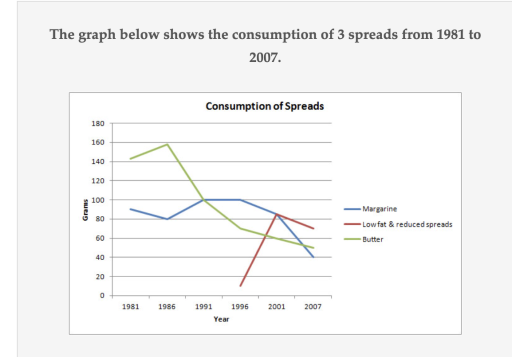
The line graph shows the consumption of margarine, low-fat and reduced spreads, and butter between 1981 and 2007. The units are measured in grams per person per week.
Overall, while spreads such as butter and margarine saw a decrease in consumption over the period, there was a significant rise in the popularity of low-fat and reduced spreads.
Regarding butter and margarine, initially in 1981, the former was the most consumed spread with approximately 140 grams per person per week. After its consumption reached a peak of nearly 160 grams in 1986, it then showed a sharp decline to under 60 grams in 2007. The consumption of margarine started lower than that of butter at around 90 grams. In 1991, it overtook butter’s figure at 100 grams, but then followed a similar downward trend to it, finishing slightly lower at around 50 grams in 2007.
As for low-fat and reduced spreads, they were introduced in 1996 with the amount of merely 10 grams eaten. Their consumption then experienced a rapid growth to peak at about 90 grams in 2001, surpassing butter consumption in the 2000s and becoming the most consumed spread by 2007 despite a slight decrease to roughly 70 grams.
Word Count: 200
