Our system will evaluate the answer based on this AI-generated description.
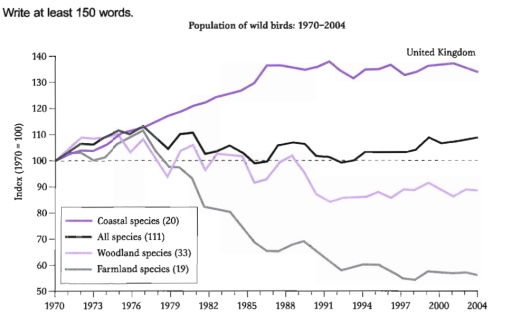
The image features a line graph titled "Population of wild birds: 1970-2004" focusing on the United Kingdom, plotting indices for four bird population categories, depicted over the years 1970 to 2004. The vertical axis ranges from 50 to 140 (index = 1970 = 100), and the horizontal axis represents time. Each category's bird population is represented by a specific line: Coastal species (20 species), All species (111 species), Woodland species (33 species), and Farmland species (19 species). Initially, in 1970, all categories start at an index of 100. Patterns vary distinctly among categories through years:
1. Coastal species index shows a fairly steady increase, starting at 100 in 1970, dipping slightly in the early 1970s, then climbing gradually, reaching around 120 in 2004.
2. All species index begins at 100 in 1970, decreases slightly to below 100 by 1976, fluctuates mildly around this range, and ends near 100 again in 2004.
3. Woodland species index starts at 100 in 1970, exhibits some fluctuation, dipping to approximately 90 by mid-1970s, recovering to 100 by 1980, with slight rises and falls, ending just below 100 by 2004.
4. Farmland species index begins at 100, shows a sharp decline to about 60 by mid-1980s, and maintains a relatively flat trend but slightly recuperates, closing near 70 in 2004.
Given the complexity of the image, the above description may not be entirely accurate.
Skyrocket your IELTS band score by 1-2 points in under a month with our premium plan!
Note: Both the topic and the answer were created by one of our users.
The given line graph demonstrates the population figures of four various types of wild birds: Coastal species, Woodland species, Farmland Species and All species in the United Kingdom.The share is measured in specific index and data is provided between 1970 and 2004.
Overall, Coastal species illustrate the upward trend, while all species, woodland species and farmland species show the downward tendency.
According to the graph, it is noticable that the Coastal species, Woodland species, Farmland Species and All species index was equal to approximately 100 in 1973.Moreover, Coastal species were the only one example for the gradual increase in period of 1971-1985.After that, Coastal species illustrated slight fluctuatuions between 1986 and 2004. It is clear that these category of wild birds occupied the leading position among all types of birds from 1970 to 2004.
It is clear that, Woodland species, Farmland Species and All species had similar pattern. From 1970 to 1976 they increased moderately in 10.Afterwards, all categories with some fluctuations remain steady, while Woodland species dropped. What is more, Farmland species plummeteed dramatically from 1979 to 2004 in roughly 50%
Word Count: 182
