Our system will evaluate the answer based on this AI-generated description.
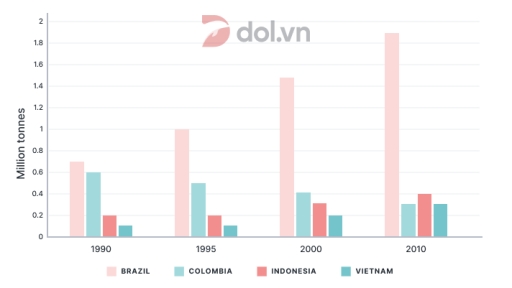
The image presents a bar graph illustrating the production of an unspecified item in million tonnes from 1990 to 2010 for Brazil, Colombia, Indonesia, and Vietnam. In 1990, Brazil produced approximately 0.8 million tonnes, Colombia around 0.2 million tonnes, Indonesia roughly 0.6 million tonnes, and Vietnam close to 0.4 million tonnes. In 1995, Brazil's production increased to around 1 million tonnes, Colombia's slightly rose to just above 0.2 million tonnes, Indonesia's jumped to nearly 1.4 million tonnes, and Vietnam's escalated to approximately 1.6 million tonnes. By 2000, Brazil's production decreased to about 0.4 million tonnes, Colombia's remained stable at just above 0.2 million tonnes, Indonesia's reduced to roughly 0.8 million tonnes, and Vietnam's slightly increased to nearly 1.8 million tonnes. Lastly, in 2010, Brazil produced around 0.2 million tonnes, Colombia approximately 0.2 million tonnes, Indonesia close to 0.4 million tonnes, and Vietnam maintained its production at nearly 1.8 million tonnes.
Given the complexity of the image, the above description may not be entirely accurate.
Skyrocket your IELTS band score by 1-2 points in under a month with our premium plan!
Note: Both the topic and the answer were created by one of our users.
The chart illustrates the coffee production in 4 varied regions in the in a different times from 1990 to 2010. Units are measured in million tonnes.
Overall, it is clear that the Brazil produced bigger amout in comparison with Vietnam who has mostly lagged behind . The production of coffee raised up in all the countries. Furthermore, the most significant changes hapenned in Brazil, while in the the changes are less visible.
In 1990, the difference between regions was not very noticeable. For constant, comparing Brazil and Colombia with only 0,1 million tonnes of variation, same as Indonesia and Vietnam. However, in 1995 Brazil rose on 0,3 million tones as opposed to Colombia whose manufacturing dropped on 0,1 million tonnes. Other 2 countries maintained the indicators on the same level.
Later on, in 2000 and 2010, which is a longer period, Brazil extremely continued to grow and other countries either stabilized in the numbers or fell down. Such as Vietnam whose indicators fell down by 2010.
Word Count: 166
