Our system will evaluate the answer based on this AI-generated description.
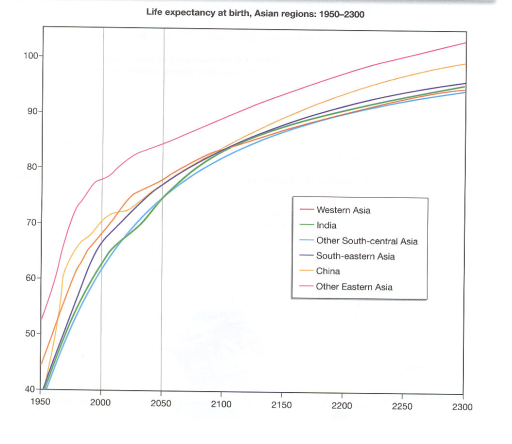
The image shows a line graph displaying the life expectancy at birth for various Asian regions from 1950 to 2300. The y-axis represents life expectancy in years, ranging from 40 to 100, and the x-axis represents the years from 1950 to 2300 in increments of 50 years. There are six colored lines representing Western Asia (blue), India (red), Other South-central Asia (orange), China (green), South-eastern Asia (purple), and Other Eastern Asia (yellow). Each line starts at different points in 1950, with Western Asia having the highest life expectancy around 67 years, and Other South-central Asia having the lowest at approximately 41 years. All lines show an upward trend, with Western Asia maintaining the highest life expectancy throughout the years, reaching close to 100 years by 2300. The other regions show varying degrees of increase, with India and Other Eastern Asia reaching around 95 years, Other South-central Asia and South-eastern Asia reaching around 90 years, and China having a slightly lower life expectancy around 87 years by 2300.
Given the complexity of the image, the above description may not be entirely accurate.
Skyrocket your IELTS band score by 1-2 points in under a month with our premium plan!
Note: Both the topic and the answer were created by one of our users.
The line graph illustrates the life perdiction of people living in Asian regions from 1950 and projections life expectancy until 2300.
Overall, it is clear that life expectancy at birth in six different countries India, china and other regions of Asia increased during the given period from 1950 and 2300.
In 1950, the birth ratio of people in India, other South-central Asia, South eastern asia, and china was 40%, while this percentage in china and South-eastern Asia more increased as copmared to India and other South-central asia. In 2000, the ratio of birth in South-eastern and China was aproximately 65% and 70% respectively, whereas in India and South central asia the figure was about to 63%. This percentage will goes to around 77% in 2050 and will continue jump up to about 90% until 2300.
By contrast, in 1950, the proportion of birth in Western-asia and other Eastern Asia was 45% and 55% respectively, but the ratio in Western-Asia rapidly surged above to 80%, and in other Eastwrn Asian regions increased to around 70%. However, the population figure in Western asia continuesly soar and will be reached above to 100%,whereas this ratio in other Eastern Asian regions will be gone to about 90% in 2300.
Word Count: 205
