🔥 Today Only: Save 30% on Premium — Offer Ends Soon! - Upgrade Now!
Line Graph

Band 6+: The graph shows the life expectancy of people living in Asian regions from 1950 and predicts life expectancy until 2300. Summarize the information by selecting and reporting the main features, and make comparisons where relevant.

Image for topic: The graph shows the life expectancy of people living in Asian regions from 1950 and predicts life expectancy until 2300. Summarize the information by selecting and reporting the main features, and make comparisons where relevant.
Our system will evaluate the answer based on this AI-generated description.
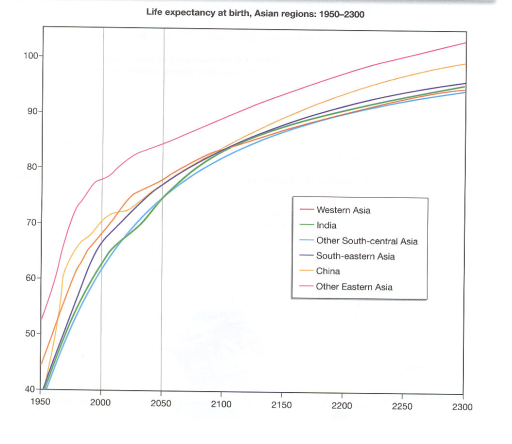
The image shows a line graph displaying the life expectancy at birth for various Asian regions from 1950 to 2300. The y-axis represents life expectancy in years, ranging from 40 to 100, and the x-axis represents the years from 1950 to 2300 in increments of 50 years. There are six colored lines representing Western Asia (blue), India (red), Other South-central Asia (orange), China (green), South-eastern Asia (purple), and Other Eastern Asia (yellow). Each line starts at different points in 1950, with Western Asia having the highest life expectancy around 67 years, and Other South-central Asia having the lowest at approximately 41 years. All lines show an upward trend, with Western Asia maintaining the highest life expectancy throughout the years, reaching close to 100 years by 2300. The other regions show varying degrees of increase, with India and Other Eastern Asia reaching around 95 years, Other South-central Asia and South-eastern Asia reaching around 90 years, and China having a slightly lower life expectancy around 87 years by 2300.
Given the complexity of the image, the above description may not be entirely accurate.
Note: Both the topic and the answer were created by one of our users.

The presented graph illustrates the changes in the life span of the residents of six different Asian regions over a 350-year period.

Overall, the life expectancy of dwellers in all regions experienced a sharp rise from 1950 until now, and although with a relatively lower steep, it is expected that the trend will continue until 2300.

The life span of people living in these regions was significantly lower in 1950 compared to the present. In 1950, the highest life expectancy was for inhabitants of Other Eastern Asia, with a 53 year life expectancy, reaching around 80 year now. The duration of life for people living in Western Asia has increased from 45 year to 70 year since 1950. The lowest life expectation, lower than 40 years, was recognized for inhabitants of India, South-eastern Asia, Other South-central Asia and China in 1950, which has spanned to more than 60 year at the present.

It is forecast that lifespan of inhabitants of Other Eastern Asia will reach a little more than 100 year until 2300, remaining at the first place among all regions. The life expectancy in China is estimated to be around 98 year in 2300, and other regions will probably reach around 90 year by then.

Word Count: 206

Answers On The Same Topic:

The graph shows the life expectancy of people living in Asian regions from 1950 and predicts life expectancy until 2300. Summarize the information by selecting and reporting the main features, and make comparisons where relevant.

The line graph illustrates the changes in life expectancy in six distinct Asian regions between 1950 and 2300. Overall, it is clear that life expectancy in all regions is expected to increase significantly over the entire 350-year period. Additionally, people in Other Eastern Asia consistently have the highest life expectancy. In 1950, life expectancy was […]

The graph shows the life expectancy of people living in Asian regions from 1950 and predicts life expectancy until 2300. Summarize the information by selecting and reporting the main features, and make comparisons where relevant.

The line graph illustrates the historical and projected life expectancy at birth across six different Asian regions from 1950 to 2300. Overall, it is clear that life expectancy in all regions is expected to increase significantly over the entire 350-year period. The most rapid growth is observed between 1950 and 2050, after which the upward […]

The graph shows the life expectancy of people living in Asian regions from 1950 and predicts life expectancy until 2300. Summarize the information by selecting and reporting the main features, and make comparisons where relevant.

The graph above showes the expectancy age for people who living in Asia from the year 1950 until the year 2300. Overall, the expectancy age of people in Asia is increasing steadily with the past of the time. In the first period that was between 1950 and 2000, the average age of people increased significantly […]

The graph shows the life expectancy of people living in Asian regions from 1950 and predicts life expectancy until 2300. Summarize the information by selecting and reporting the main features, and make comparisons where relevant.

The line graph illustrates the changes in life expectancy at birth in various Asian regions from 1950 and provides predictions up to the year 2300. Overall, it is clear that life expectancy in all regions is expected to rise significantly over the entire period. While there were noticeable differences between the regions in the past, […]

The graph shows the life expectancy of people living in Asian regions from 1950 and predicts life expectancy until 2300. Summarize the information by selecting and reporting the main features, and make comparisons where relevant.

The graph illustrates the life expectancy at birth in different Asian regions from 1950-2300. Overall, the life expectancy shows a rise in every asian region as the years go on, with other eastern asia being the highest region and south central asia being the lowest. In 1950, South-Central Asia, India, South-eastern Asia, and China had […]

See All

Other Topics:

Task 1: (Line Graph) Differing amount of nitrogen oxide by four types of vehicles.

The line graph illustrates the nitrogen oxide emissions generated by four distinct vehicles. Overall, it is clear that the nitrogen oxide emissions produced by buses moderately climb, while lorries’ nitrogen oxide emissions significantly decrease. It is also noticeable that petrol cars and diesel cars experience no change in their nitrogen oxide emissions. Regarding buses, the […]

The line chart below shows the percentage of households owning a car in four countries from 2000 to 2020.

The table illustrates the proportion of households that had a car in each country during 20 year-period between 2000 and 2020. It can clearly be seen that the percentage of households travelling by car had increased in each country; Germany demonstrates the biggest rates, whilst the population with the lowest car usage was in India […]

The graph below shows the number of immigrants to three countries from 1900 to 2001.

The line graph compares the changes of the annual number of immigrants who moved to the USA, Canada, and Australia. Overall, it is immediately salient that Australia and Canada experienced a remarkable upward trend, whereas the converse was true for USA, which witnessed a steady decline throughout the timescale. Additionally, the most dramatic growth was […]

The line graph below shows the average monthly expenditure (in dollars) of households in a country on three different types of food between 2010 and 2020. Summarise the information by selecting and reporting the main features, and make comparisons where relevant.

The line graph illustrates the monthly expenditure of households on three types of food – fruit and vegetables, meat and fish, grains and cereals – in a country between 2010 and 2020. Overall, meat and fish figure showed the highest rate by 2020, rising constantly throughout the whole period. In contrast, grains and cereals were […]

The chart below shows the worldwide use of different kinds of information and communication technology (ICT) from 1998 to 2008. Summarize the information by selecting and reporting the main features and make comparisons where relevant.

The line graph delineates the worldwide use of various kinds of information and communication technology, namely landline, mobile phone, fixed broadband, Internet, and Wifi between 1998 and 2008. Overall, it is evident that all of these categories witnessed an upward trend over the period. Specfically, the figure for mobile phone experienced a significant increase whereas […]

The line graph below shows the average amount of fast food consumed per person per week in three countries between 1980 and 2020. Summarise the information by selecting and reporting the main features, and make comparisons where relevant.

The line chart illustrates the variations in the consumption of fast food per person per week in USA, UK, and Japan from 1980 to 2020. Overall, it is evident that the average amount of fast food consumed per person in the UK and Japan went up throughout the period, whereas graph for USA showed a […]

See All
We have detected unusual activity on your device.
Please verify your identity to continue.
Note: This verification step won't sign you in. If you have a premium account, please log in to access the service as usual.
Google/Gmail Verification
Or verify using Email/Code
We've sent a verification code to:
youremail@gmail.com (Not your email?)
Enter it below to complete the verification process.
Ensure your email address is correct, your inbox is not full, and you check your spam folder. If no email arrives, consider using an alternative email.
You will need a Premium plan to perform your action!
Note: If you already have a premium account, please log in to access our services as usual.

Plans & Pricing

Our mission is to make quality education accessible for everyone.
However, to keep our hardworking team running and this service alive, we genuinely need your support!
By opting for a premium plan, not only do you sustain us in achieving the mission, but you also unlock advanced features to enrich your learning experience.

Free

For learners who aren't pressed for time

What's included on Free
100+ Cambridge IELTS Tests
Instant IELTS Writing Task 1 & 2 Evaluation (2 times/month)
Instant IELTS Speaking Part 1, 2, & 3 Evaluation (2 times/month)
Instant IELTS Writing Task 1 & 2 Essay Generator (2 times/month)
500+ Dictation & Shadowing Exercises
100+ Pronunciation Exercises
Flashcards
Other Advanced Tools

Premium

For those serious about advancing their English proficiency, and for IELTS candidates aspiring to boost their band score by 1-2 points (especially in writing & speaking) in just 30 days or less

What's included on Premium
Save Your IELTS Test Progress & Analyze Mistakes By Question Type
Save Your Own Flashcard Sets & Use Them On Any Device
Unlock All Courses, IELTS Tests, Section & Part Practice
Unlimited AI Conversations
Unlimited AI Writing Enhancement Exercises
Unlimited IELTS Writing Task 1 & 2 Evaluation
Unlimited IELTS Speaking Part 1, 2, & 3 Evaluation
Checked Answers Will Not Be Published
Unlimited IELTS Writing Task 1 & 2 Essay Generator
Unlimited IELTS Speaking Part 1, 2, & 3 Sample Generator
Unlimited Usage Of Advanced Tools & AI Features
Priority Support within 24h (12-month plan only)

Due to the nature of our service and the provided free trials, payments are non-refundable.