Our system will evaluate the answer based on this AI-generated description.
The image shows a line graph of 15 year-olds with low literacy levels from 2000 to 2009 for Austria, Denmark, Ireland, and Sweden. In 2000, Austria started at about 18%, Denmark at 16%, Ireland at 12%, and Sweden at 10%. In 2003, Austria increased to about 19%, Denmark stayed the same, Ireland increased to about 13%, and Sweden increased to about 11%. In 2006, Austria increased dramatically to about 27%, Denmark increased to about 17%, Ireland increased to about 15%, and Sweden increased to about 12%. In 2009, Austria decreased to about 26%, Denmark increased to about 18%, Ireland increased to about 17%, and Sweden increased to about 14%. The y-axis represents the percentage of 15 year-olds with low literacy levels, while the x-axis represents the years. Each country is represented by a different colored line: Austria (blue), Denmark (purple), Ireland (yellow), and Sweden (green).
Given the complexity of the image, the above description may not be entirely accurate.
Skyrocket your IELTS band score by 1-2 points in under a month with our premium plan!
Note: Both the topic and the answer were created by one of our users.
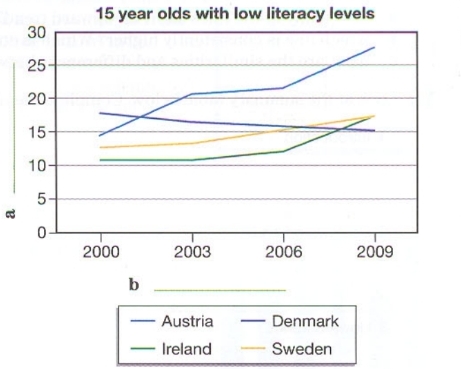
The linegraph illustrates the distribution of low literacy skilleds among 15-year-olds in Austria, Denmark, Ireland and Sweden.
Overall, percentage of teenagers who can barely read and write in Austria, Ireland and Sweden grew gradually throughout the given period.Meanwhile, Denmark’s distribution declined in 9 years.
While low literacy percentage skyrocketed in sweden from around 14 to a whopping 21 percent in 2003. However, Ireland and sweden remained steady until 2003. Teenagers with low literacy skills almost remained the same in the following 3 years while, Ireland and Sweden climbed up to estimately 13 and 15 by 2006. All 3 of them soared in 2009 with nearly 28 in Sweden and 18 in Austria and Ireland.
Denmark’s teenage low literacy slightly went down from almost 18 to 16 percent in 2003. It countined gradually declining throughout the 6 year span stopping at approximately 15 percent in 2009.
Word Count: 145
