Our system will evaluate the answer based on this AI-generated description.
The image shows a line graph of 15 year-olds with low literacy levels from 2000 to 2009 for Austria, Denmark, Ireland, and Sweden. In 2000, Austria started at about 18%, Denmark at 16%, Ireland at 12%, and Sweden at 10%. In 2003, Austria increased to about 19%, Denmark stayed the same, Ireland increased to about 13%, and Sweden increased to about 11%. In 2006, Austria increased dramatically to about 27%, Denmark increased to about 17%, Ireland increased to about 15%, and Sweden increased to about 12%. In 2009, Austria decreased to about 26%, Denmark increased to about 18%, Ireland increased to about 17%, and Sweden increased to about 14%. The y-axis represents the percentage of 15 year-olds with low literacy levels, while the x-axis represents the years. Each country is represented by a different colored line: Austria (blue), Denmark (purple), Ireland (yellow), and Sweden (green).
Given the complexity of the image, the above description may not be entirely accurate.
Skyrocket your IELTS band score by 1-2 points in under a month with our premium plan!
Note: Both the topic and the answer were created by one of our users.
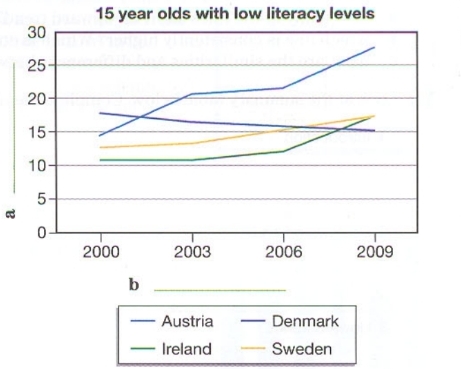
The line graph compares changes in the proportions of the children aged 15 who were bad at reading and writing in Austria, Denmark, Ireland and Sweden from 2000 to 2009.
Overall, with the exception of Denmark, the remaining three countries experienced substantial increases throughout the period. Besides, Austria became the dominant in terms of having illiterate teenagers, Denmark recorded the lowest share towards the end of the survey.
In 2000, the rate of 15 years -olds in Denmark accounted for roughly 18%, which was 4% higher than the figure for Austria. However, the former declined gradually within 9 years, dipping the lowest point in 2009. The latter, on the other hand, first saw a sharp rise (over 20%), then it was followed by a slight growth with approximately 22% before soaring and hitting the highest level in the final year (27%).
Regarding Sweden’s and Ireland’s low literacy children aged 15, although they had a minimal gap initially (11%;13%), the both figures grew significantly over the period of nine years, reaching the same level in 2009, constituting about 14%.
Word Count: 178
