Our system will evaluate the answer based on this AI-generated description.
The image shows a line graph titled 'PARTICIPATION BY CLUB MEMBERS' with the Y-axis labeled '% OF CLUB MEMBERS' ranging from 0% to 60% in increments of 10%, and the X-axis labeled 'YEAR' with markers for 1995, 2000, 2005, 2010, 2015. Three lines represent swimming, team sports, and gym activities. In 1995, swimming starts at just below 50%, team sports at just above 30%, and gym activities at just over 20%. By 2000, swimming decreases to just over 40%, team sports increase to just over 40%, and gym activities rise to about 25%. In 2005, swimming continues to decline to around 35%, team sports drops to just above 30%, gym activities climb to just over 30%. By 2010, swimming reaches around 30%, team sports rises to above 35%, and gym activities peak at near 40%. In 2015, swimming stabilizes around 30%, team sports decreases slightly to just under 35%, and gym activities dip to just below 40%.
Given the complexity of the image, the above description may not be entirely accurate.
Skyrocket your IELTS band score by 1-2 points in under a month with our premium plan!
Note: Both the topic and the answer were created by one of our users.
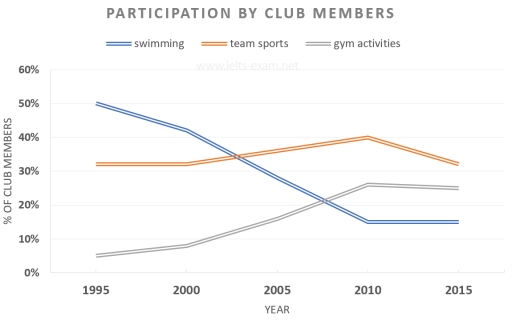
The graph gives information about changes in the popularity of three different activities in a UK sports club commencing in the year 1995 over a 20-year timescale.
Overall, participation in swimming experienced a steep fall over a period of 20 years. Team sports, however, stayed virtually unchanged; on the other hand, gym activities witnessed a significant rise during the period.
According to the given line chart, in 1995, the rates of members engage in gym activities started at 5% respectively, which was lower than that of swimming. However, the number of participants in gym activities underwent a fivefold rise over a 20-year course. In stark contrast, the proportion of people taking part in swimming fell considerably from 50%, eventually leveling off at 15% in the last 5 years.
Looking at the participation rates in team sports, the figure remained almost unchanged between 1995 and 2015. While there seems to be fluctuation starting from 2000 before finally reaching a peak at 40%, during the last 5 years, it began to return to its initial rate of around 31%.
Word Count: 177
