Our system will evaluate the answer based on this AI-generated description.
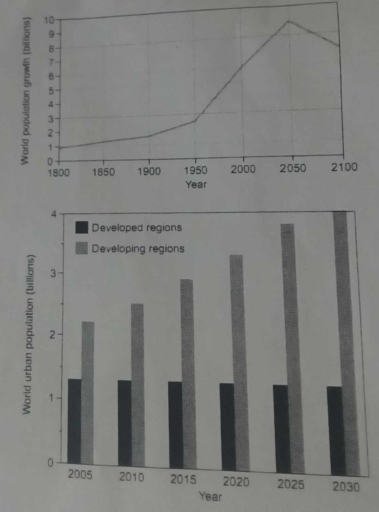
The image contains two graphs. The first graph, a line graph, displays the world population from 1800 to 2100 in billions, with points marked at 1800 (approximately 1 billion), 1900 (approximately 1.6 billion), 1950 (approximately 2.5 billion), 2000 (approximately 6 billion), 2050 (around 9 billion), and 2100 (a decline to about 7 billion). The second graph, a bar graph, shows the world urban population in billions, split into developed and developing regions from 2005 to 2030, with values for developed regions in 2005 (approximately 0.9 billion), 2010 (approximately 1 billion), 2015 (approximately 1.1 billion), 2020 (approximately 1.2 billion), 2025 (approximately 1.3 billion), 2030 (approximately 1.4 billion); and for developing regions in 2005 (approximately 1.8 billion), 2010 (approximately 2.2 billion), 2015 (approximately 2.6 billion), 2020 (approximately 3 billion), 2025 (approximately 3.4 billion), 2030 (approximately 3.8 billion).
Given the complexity of the image, the above description may not be entirely accurate.
Skyrocket your IELTS band score by 1-2 points in under a month with our premium plan!
Note: Both the topic and the answer were created by one of our users.
The line graph shows the population size across three centuries, from the 19th to the 21st. Meanwhile, the bar chart compares the population in two different regions of the globe (developed and developing regions) from 2015 to 2040.
Overall, it is evident that the world population experienced a significant increase over the period, with a sharp rise expected in 2040. It is also clear that the proportion of people in urban areas gradually rose throughout the timeline, while the figure for people in rural regions remained relatively stable.
Initially, the world population was below 2000 million, and this number remained fairly constant before a slight growth in 1960. By contrast, the global population dramatically rose from approximately 2600 million in 1960 to 8000 million in 2060. However, this number exhibited a slight decline to around 6000 million at the end of the period.
Moreover, the population in developed regions accounted for approximately 2200 million in 2015. After a substantial increase every 5 years, their population stood at 4000 million by the end of the study period, while the population in developing areas maintained a steady level at around 1300 million.
Word Count: 190
