Our system will evaluate the answer based on this AI-generated description.
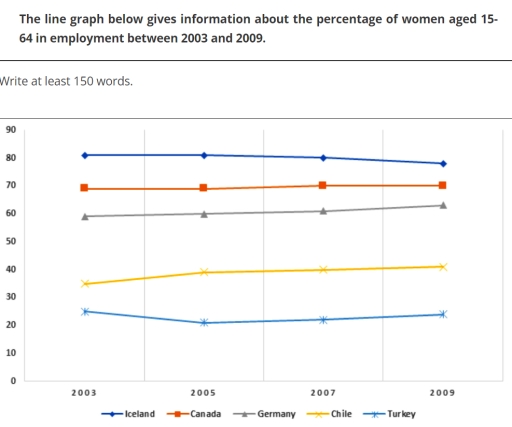
The image shows a line graph displaying the percentage of women aged 15-64 in employment between 2003 and 2009 in five different countries (Iceland, Canada, Germany, Chile, and Turkey). Data points for each country are represented by distinct shapes for each year. In 2003, Iceland had about 80%, Canada had about 70%, Germany had around 60%, Chile had approximately 35%, and Turkey started with about 25%. By 2005, Iceland's percentage increased slightly to just above 80%, Canada remained close to 70%, Germany showed a small increase to just above 60%, Chile's percentage dropped to just below 35%, and Turkey decreased to around 23%. In 2007, Iceland's percentage remained above 80%, Canada's stayed near 70%, Germany's increased to about 65%, Chile rose slightly to just above 35%, and Turkey decreased further to just above 20%. In the final year, 2009, Iceland's percentage remained steady above 80%, Canada's stayed near 70%, Germany's increased slightly to around 67%, Chile decreased to just below 35%, and Turkey decreased further to just below 20%. The graph illustrates trends over the six-year period for each country in terms of the percentage of women employed within the specified age range.
Given the complexity of the image, the above description may not be entirely accurate.
Skyrocket your IELTS band score by 1-2 points in under a month with our premium plan!
Note: Both the topic and the answer were created by one of our users.
The line chart illustrates the proportion of women were employing, once they had 15-64 years old in five different countries, namely Iceland, Canada, Germany, Chile, and Turkey, from 2003 to 2009.
Overall, it is evident that while the percentage of women in Turkey and Chile had the lowest rates, the figure for other countries were the highest percentage. Furthermore, the countries which had the increasing trend had changed the similarity pattern.
To begin with highest percentages, in 2003, the proportion of women were employed in Iceland started at around 80%, the highest percentage among all nations, and 10% and 20% higher than that of Canada and Germany, at 70% and 60%, respectively. However, while the figure for Canada remained at almost 70% over the period, both Iceland and Germany approached that after minimally changing.
In terms of lowest percentage, the percentage of women lived in Chile, which began at approximately 35%, saw a slight rise at 40% in 2009. Meanwhile, this figure for Turkish women remained unchanged at 25% during this period.
Word Count: 172
