Our system will evaluate the answer based on this AI-generated description.
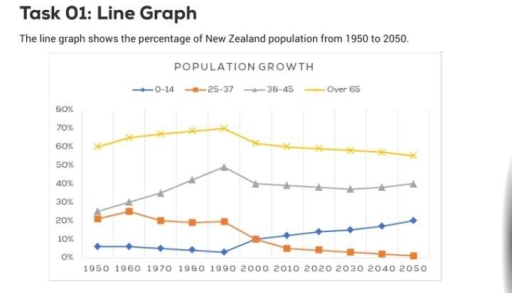
The image presents a line graph indicating population growth by age groups in New Zealand from 1950 to 2050; the age groups are 0-14, 25-37, 36-45, and over 65. In 1950, percentages for age groups were as follows: 0-14 at 45%, 25-37 at 25%, 36-45 at 20%, and over 65 at 10%. In 1960, 0-14 rose to 50%, 25-37 dropped to 20%, 36-45 remained at 20%, and over 65 increased to 15%. By 1970, all groups except 36-45 increased by 5% each, but by 1980, 0-14 declined to 40%, 25-37 grew to 30%, 36-45 stayed at 25%, and over 65 reached 20%. By 1990, 0-14 dropped to 35%, 25-37 slightly grew to 35%, 36-45 maintained at 20%, and over 65 rose to 25%. In 2000, 0-14 went down to 30%, 25-37 shrunk to 30%, 36-45 increased to 30%, and over 65 remained at 25%. In 2010, 0-14 further decreased to 25%, 25-37 went up to 40%, 36-45 slightly rose to 35%, and over 65 fell to 20%. The forecast for 2020 anticipates 0-14 at 20%, 25-37 at 45%, 36-45 at 40%, and over 65 at 30%. By 2030, 0-14 is expected to continue at 20%, 25-37 at 55%, and 36-45 at 40%, with over 65 projected to hit 35%. In 2040, predictions suggest 0-14 remaining at 20%, 25-37 peaking at 60%, 36-45 staying at 40%, and over 65 climbing to 45%. Lastly, the 2050 outlook projects 0-14 at 20%, 25-37 reducing to 55%, 36-45 maintaining at 35%, and over 65 surging to 50%.
Given the complexity of the image, the above description may not be entirely accurate.
Skyrocket your IELTS band score by 1-2 points in under a month with our premium plan!
Note: Both the topic and the answer were created by one of our users.
TThe line graph illustrates the proportion of people in New Zealand across four different age groups from 1950 to 2050.
Overall, the percentage of those aged over 65 experienced a steady upward trend over the whole period, while the proportion of those aged 25-37 is expected to decline significantly. However, the percentage of people aged 38-45 peaked around 1990 before falling and then stabilising, whereas the figure for the 0-14 age group is forecast to increase gradually.
In detail, the proportion of New Zealanders over 65 started at around 5% in 1950 and then rose slightly before increasing significantly after 2000, reaching a peak of about 20% by 2050. By contrast, the figure for the 25-37 age group witnessed a steady decline, falling from roughly 20% in 1950 to below 5% by the end of the period.
Meanwhile, the percentage of people aged 38-45 saw a significant increase from around 25% in 1950 doubled nearly 50% in 1990. After that, it decreased and remained unchanged at about 40% from 2000 onwards. Finally, the youngest age group (0-14) remained relatively stable at around 5% for most of the period but then climbed gradually, reaching around 20% by 2050.
Word Count: 197
