Our system will evaluate the answer based on this AI-generated description.
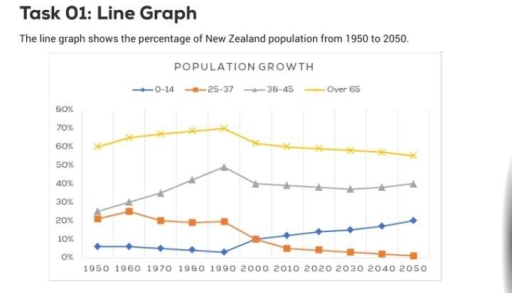
The image presents a line graph indicating population growth by age groups in New Zealand from 1950 to 2050; the age groups are 0-14, 25-37, 36-45, and over 65. In 1950, percentages for age groups were as follows: 0-14 at 45%, 25-37 at 25%, 36-45 at 20%, and over 65 at 10%. In 1960, 0-14 rose to 50%, 25-37 dropped to 20%, 36-45 remained at 20%, and over 65 increased to 15%. By 1970, all groups except 36-45 increased by 5% each, but by 1980, 0-14 declined to 40%, 25-37 grew to 30%, 36-45 stayed at 25%, and over 65 reached 20%. By 1990, 0-14 dropped to 35%, 25-37 slightly grew to 35%, 36-45 maintained at 20%, and over 65 rose to 25%. In 2000, 0-14 went down to 30%, 25-37 shrunk to 30%, 36-45 increased to 30%, and over 65 remained at 25%. In 2010, 0-14 further decreased to 25%, 25-37 went up to 40%, 36-45 slightly rose to 35%, and over 65 fell to 20%. The forecast for 2020 anticipates 0-14 at 20%, 25-37 at 45%, 36-45 at 40%, and over 65 at 30%. By 2030, 0-14 is expected to continue at 20%, 25-37 at 55%, and 36-45 at 40%, with over 65 projected to hit 35%. In 2040, predictions suggest 0-14 remaining at 20%, 25-37 peaking at 60%, 36-45 staying at 40%, and over 65 climbing to 45%. Lastly, the 2050 outlook projects 0-14 at 20%, 25-37 reducing to 55%, 36-45 maintaining at 35%, and over 65 surging to 50%.
Given the complexity of the image, the above description may not be entirely accurate.
Skyrocket your IELTS band score by 1-2 points in under a month with our premium plan!
Note: Both the topic and the answer were created by one of our users.
The line graph illustrates the percentage of New Zealand’s population in different age groups between 1950 and 2050.
Overall, it can be seen that the proportion of older people is expected to rise significantly, while the percentage of younger age groups will decline over the period. This indicates an ageing population in New Zealand.
In 1950, the largest group was those aged 15-39, making up around 40% of the total population. However, this figure gradually decreased and is projected to fall to about 30% by 2050. Similarly, the proportion of children aged 0-14 is expected to decline from just under 30% in 1950 to roughly 15% by the end of the period.
In contrast, the percentage of people aged 65 and over is predicted to increase sharply. Starting at around 10% in 1950, this group rose steadily and is expected to reach around 25% by 2050, becoming almost equal to the 15-39 age group. The proportion of middle-aged adults (40-64) also shows a moderate rise from about 20% to nearly 30% during the same time frame.
In conclusion, New Zealand’s population structure has been shifting towards an older demographic, with a growing number of elderly people and fewer young citizens projected in the future.
Word Count: 204
