Our system will evaluate the answer based on this AI-generated description.
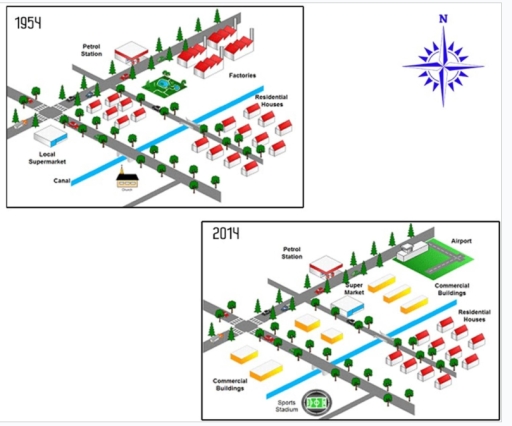
The image presents two isometric maps comparing urban layouts for the years 1954 and 2014. In the 1954 map: there are multiple residential houses arranged in rows, a petrol station located near the lower left, one local supermarket adjacent to the petrol station, a canal running horizontally near the lower side, and three blocks of factories behind the residential houses. In the 2014 map: the setup includes several residential houses, a petrol station retained in the same position, a larger supermarket labeled "Super Market," expanded commercial buildings spread across the middle of the setup, a new sports stadium named "Sports Stadium" toward the lower right, and an airport located at the upper right. The layouts also showed an increased road network in 2014. No specific numerical data or percentages about sizes, number of buildings, or population data are provided in the image.
Given the complexity of the image, the above description may not be entirely accurate.
Skyrocket your IELTS band score by 1-2 points in under a month with our premium plan!
Note: Both the topic and the answer were created by one of our users.
The provided illustrations depict the transformation of an American town from 1948 to 2010.
Overall, significant changes can be observed over this period, particularly in terms of infrastructure, commercial development, and residential areas.
In 1948, the town featured a straightforward layout, including a petrol station, a local supermarket, a church, a canal, and numerous residential houses. There was also a small factory area located in the northeastern part of the town. A park with a pond was situated near the center, and trees were scattered along the streets.
By 2010, the town experienced major modernization. The factory area had been replaced by commercial buildings, and an airport was constructed in the northeast. The local supermarket was relocated to a more central position and expanded into a larger facility. Additionally, a sports stadium was built in the southern part of the town, replacing the church. The existing residential houses were renovated, and more commercial buildings emerged along the streets.
In summary, the town underwent significant development, evolving from a small industrial community into a more commercialized and modern city.
Word Count: 178
