Our system will evaluate the answer based on this AI-generated description.
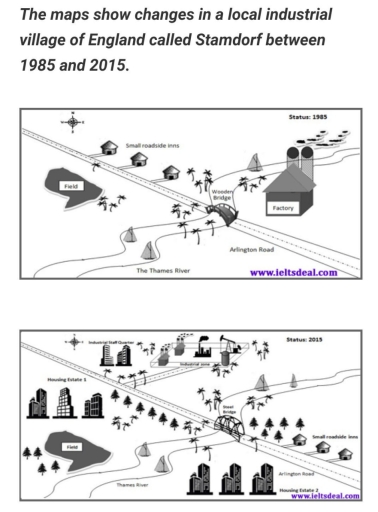
The image presents two maps illustrating the transformation of Stamdorf, an industrial village in England, from 1985 to 2015. In 1985, Stamdorf featured the Thames River flowing horizontally across the map, Arlington Road running parallel above it, a factory situated by the river’s upper bend with access to Arlington Road via a connecting road, four small roadside inns dispersed along Arlington Road, a wooden bridge over the river, and a field positioned on the distant side of Arlington road opposite the factory. In contrast, the 2015 map indicates significant development: the factory remains but now includes two additional road connections to Arlington Road, the small roadside inns have been replaced by housing estates labeled 1 to 3, and the wooden bridge has been upgraded to a solid bridge. Moreover, the field area is reduced considerably and a new road has been constructed connecting the houses to Arlington Road, with two housing estates situated near this new road and another close to the upgraded bridge. The Thames River and Arlington Road maintain their relative positions from the earlier map.
Given the complexity of the image, the above description may not be entirely accurate.
Skyrocket your IELTS band score by 1-2 points in under a month with our premium plan!
Note: Both the topic and the answer were created by one of our users.
The maps show how the industrial village of Stamdorf in England changed between 1985 and 2015.
Overall, the village became more developed, with more buildings, an industrial area, and better infrastructure. The biggest changes include the replacement of the factory with an industrial zone, the construction of housing estates, and the improvement of the bridge.
In 1985, there was a factory in the northeast, and a wooden bridge connected the two sides of the village over the Thames River. A few small roadside inns were located along the western road, and a large field was in the west. Arlington Road passed through the village, linking different areas.
By 2015, the factory was replaced by a large industrial zone, which included chimneys and an oil rig. Next to it, an industrial staff quarter was built. The wooden bridge was replaced with a stronger steel bridge. Two housing estates were developed—one near the field in the west and another in the south, next to Arlington Road. However, the small roadside inns and the field remained unchanged.
In conclusion, Stamdorf changed a lot over 30 years, becoming more industrialized and urbanized, with modern housing and infrastructure.
Word Count: 193
