Our system will evaluate the answer based on this AI-generated description.
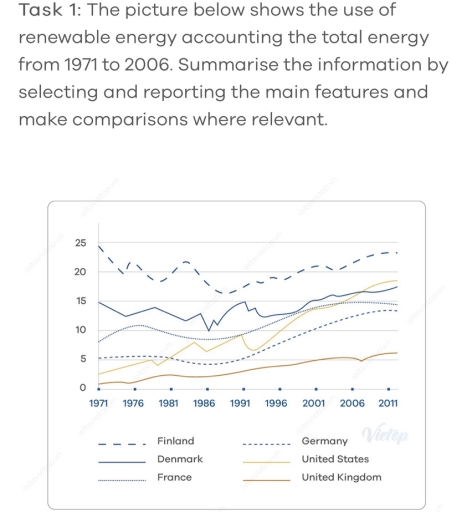
The image displays a line graph comparing the use of renewable energy from 1971 to 2006 in six countries: Finland, Denmark, Germany, United States, France, and United Kingdom. The y-axis represents the percentage use of renewable energy ranging from 0 to 25%, while the x-axis covers selected years from 1971 to 2011 (1971, 1976, 1981, 1986, 1991, 1996, 2001, 2006, 2011). The lines fluctuate as follows: Finland starts near 15% in 1971, peaks around 25% in 1996, then slightly declines to just below 25% in 2006. Denmark begins slightly above 5% in 1971, shows a rising trend to nearly 20% by 2006. Germany starts at around 5%, gradually increases to approximately 10% by 2006. The US stays consistently around 5% throughout the entire period. France begins near 10% in 1971, decreases to about 5% in 1981, then remains stable through to 2006. The UK line remains consistently around 0%-2% from 1971 to 2006.
Given the complexity of the image, the above description may not be entirely accurate.
Skyrocket your IELTS band score by 1-2 points in under a month with our premium plan!
Note: Both the topic and the answer were created by one of our users.
The line chart illustrates the use of renewable energy, accounting for the total power over a period of 35 years, from 1971 to 2006.
Overall, there was an increase in six specific countries throughout the period, with the majority of consumption being in Finland.
Regarding France,Germany, and the United Kingdom, showing less modifications, shared a relatively similar pattern during that time. Starting at roughly 10, 5 and almost none, after which it witnessed a slight fluctuation before ending at approximately 15, 13, and 6, respectively. In 2006, there was a decline to 5 before recovering its growth in the United Kingdom.
Concerning the remaining of nations, significant changes were shown, around 25 was utilized in Finland, but its use declined five times in the beginning of 1976 and experienced a fluctuation over the years before ending at around 24, one time less than its original value. Denmark was at 15 as opposed to around 3 for the United States. Although Denmark climbed to the peak at 9, which was equal with France in 1991, finally surpassing its competitor at 2 in the last year of the period, the United States declined in 2011.
Word Count: 193
