Our system will evaluate the answer based on this AI-generated description.
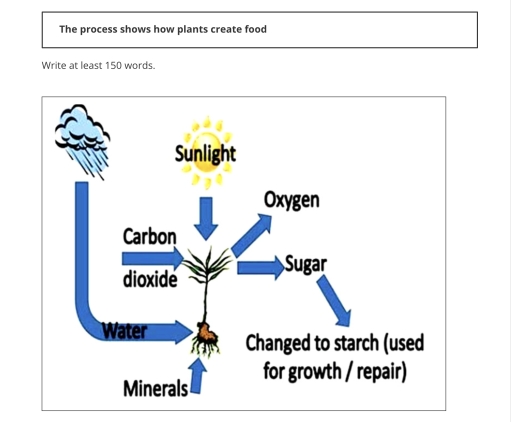
The image depicts a simplified diagram illustrating the process by which plants create food, specifically through photosynthesis. At the top left of the diagram, there's a cloud labeled, which represents the source of water. An arrow points from the cloud indicating the flow of water into the ground where a plant with leaves, roots, and a brown trunk is shown. Under the ground, labels by the roots are "Water" and "Minerals,” signifying that these are absorbed by the plant through the roots. To the right side of the plant is a representation of the sun labeled "Sunlight," indicating that sunlight is a necessary component for this process. From the sunlight, an arrow directs toward the plant, connecting to another labeled arrow pointing toward "Oxygen” and "Sugar." The sugar is then noted to be "Changed to starch (used for growth / repair)," indicating its role in the plant's metabolism. Additionally, a separate arrow shows "Carbon dioxide" moving towards the plant, which complements the flow of water and sunlight, demonstrating that carbon dioxide is also absorbed by the plant. The overall layout suggests a continuous cycle involving these elements contributing to food production in plants. The diagram does not contain specific numerical data, percentages, or detailed scientific descriptions, focusing instead on a conceptual representation of the process.
Given the complexity of the image, the above description may not be entirely accurate.
Skyrocket your IELTS band score by 1-2 points in under a month with our premium plan!
Note: Both the topic and the answer were created by one of our users.
The diagram illustrates the process by which plants produce food, known as photosynthesis. Overall, it is a natural cycle that requires sunlight, water, and carbon dioxide, and results in the production of glucose and oxygen.
At the first stage, plants absorb sunlight through their leaves. This light energy is captured by chlorophyll, a green pigment found in leaf cells. At the same time, water is taken up from the soil through the roots and transported to the leaves via the stem. In addition, carbon dioxide from the air enters the leaves through small openings called stomata.
In the next stage, these three elements – sunlight, water, and carbon dioxide – combine inside the leaves. Using the energy from sunlight, the plant converts these raw materials into glucose, which serves as food and provides energy for growth and development. As a by-product of this chemical reaction, oxygen is produced.
Finally, the oxygen is released back into the atmosphere, making it available for humans and animals to breathe. In conclusion, photosynthesis is an essential process that not only allows plants to survive but also supports life on Earth.
Word Count: 186
