Our system will evaluate the answer based on this AI-generated description.
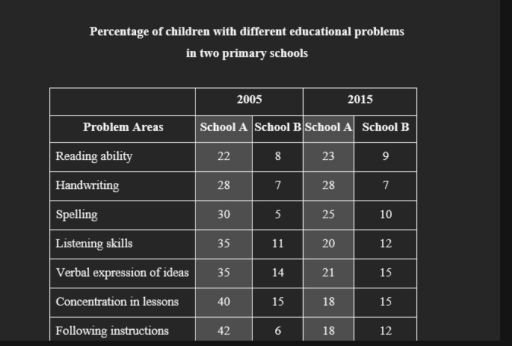
The image presents a table with data on the percentage of children with different educational problems in two primary schools across two years, 2005 and 2015. Problem areas are divided into Reading ability, Handwriting, Spelling, Listening skills, Verbal expression of ideas, Concentration in lessons, and Following instructions. School A in 2005 shows 22% in Reading ability, 28% in Handwriting, 30% in Spelling, 35% in Listening skills, 35% in Verbal expression of ideas, 40% in Concentration in lessons, and 42% in Following instructions. School B in 2005 shows 8% in Reading ability, 7% in Handwriting, 5% in Spelling, 11% in Listening skills, 14% in Verbal expression of ideas, 15% in Concentration in lessons, and 6% in Following instructions. In 2015, School A percentages are 23% in Reading ability, 28% in Handwriting, 25% in Spelling, 20% in Listening skills, 21% in Verbal expression of ideas, 18% in Concentration in lessons, and 18% in Following instructions. In 2015, School B percentages are 9% in Reading ability, 7% in Handwriting, 10% in Spelling, 12% in Listening skills, 15% in Verbal expression of ideas, 15% in Concentration in lessons, and 12% in Following instructions.
Given the complexity of the image, the above description may not be entirely accurate.
Skyrocket your IELTS band score by 1-2 points in under a month with our premium plan!
Note: Both the topic and the answer were created by one of our users.
The diagram provides the information of children ratio facing educational difficulties in 7 vary skills; Reading, spelling, listening, verbal ideating, concentration, and obey instructions by collecting the data from two school named school A and B for 2 times with a gap of decade.
Overall, both of school A and B improved lots in almost every areas. Only percentage of kids with handwriting problem is remain the same .Other 6 fields are developed in good way, proportion of students with obstacles in those skills are either dramatically or slightly declined.
In terms of school A, other point except from common characteristics mentioned before, to pickup is considerable decrease in percentage of children having error in following what they instructed. This shows that they improved such a lot in this area, from about1 in 2 of students couldn’t do things what they told to do, after ten years more than 90% of them are able to do that. This is such an incredible growth in school educational system and not only this, they developed in every other areas except one, handwriting but this isn’t became worse, they just stayed still.
Turn into school B, the change trends in this school is in the same direction with school A. Their start point in 2015 is quite better than school A and through the decennium they didn’t stop updating themselves. every figure decreased.
Word Count: 230
