Our system will evaluate the answer based on this AI-generated description.
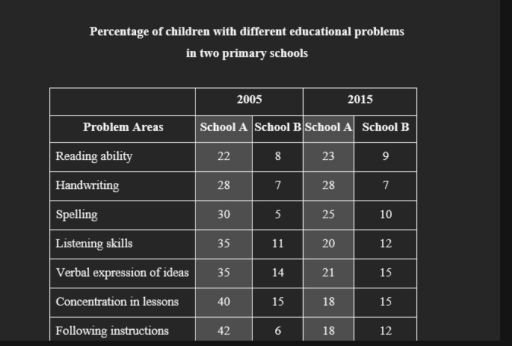
The image presents a table with data on the percentage of children with different educational problems in two primary schools across two years, 2005 and 2015. Problem areas are divided into Reading ability, Handwriting, Spelling, Listening skills, Verbal expression of ideas, Concentration in lessons, and Following instructions. School A in 2005 shows 22% in Reading ability, 28% in Handwriting, 30% in Spelling, 35% in Listening skills, 35% in Verbal expression of ideas, 40% in Concentration in lessons, and 42% in Following instructions. School B in 2005 shows 8% in Reading ability, 7% in Handwriting, 5% in Spelling, 11% in Listening skills, 14% in Verbal expression of ideas, 15% in Concentration in lessons, and 6% in Following instructions. In 2015, School A percentages are 23% in Reading ability, 28% in Handwriting, 25% in Spelling, 20% in Listening skills, 21% in Verbal expression of ideas, 18% in Concentration in lessons, and 18% in Following instructions. In 2015, School B percentages are 9% in Reading ability, 7% in Handwriting, 10% in Spelling, 12% in Listening skills, 15% in Verbal expression of ideas, 15% in Concentration in lessons, and 12% in Following instructions.
Given the complexity of the image, the above description may not be entirely accurate.
Skyrocket your IELTS band score by 1-2 points in under a month with our premium plan!
Note: Both the topic and the answer were created by one of our users.
The table presents the percentage of children experiencing various educational difficulties in two primary schools in 2005 and 2015.
Overall, School A had a significantly higher percentage of students struggling with educational issues compared to School B in both years. However, while School A saw a noticeable improvement across all problem areas over the decade, School B experienced a slight increase in difficulties.
In 2005, the most prevalent issues in School A were following instructions (42%), concentration in lessons (40%), and verbal expression of ideas (35%). However, by 2015, these figures had dropped significantly to 18%, 18%, and 21%, respectively. Similarly, listening skills, which affected 35% of students in 2005, declined to 20% in 2015. Although handwriting remained unchanged at 28%, spelling difficulties decreased from 30% to 25%.
Conversely, School B had far fewer students facing educational challenges, with the highest recorded issue in 2005 being concentration in lessons at 15%. By 2015, this figure rose slightly to 15%, alongside small increases in reading ability (from 8% to 9%), spelling (from 5% to 10%), listening skills (from 11% to 12%), and following instructions (from 6% to 12%). Handwriting, however, remained stable at 7%.
In summary, School A showed a significant reduction in learning difficulties over the years, while School B saw minor increases in some areas but still maintained much lower rates of educational challenges.
Word Count: 225
