Our system will evaluate the answer based on this AI-generated description.
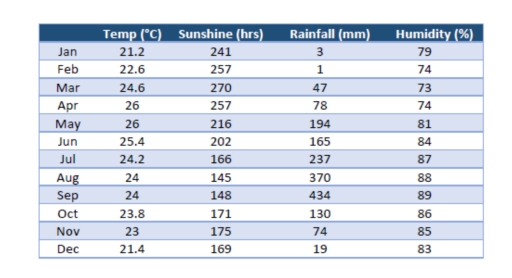
The image displays a table with data arranged in five columns corresponding to months from Jan to Dec and four types of measurements: Temp (°C), Sunshine (hrs), Rainfall (mm), and Humidity (%). Jan: Temp 21.2, Sunshine 241, Rainfall 3, Humidity 79; Feb: Temp 22.6, Sunshine 257, Rainfall 1, Humidity 74; Mar: Temp 24.6, Sunshine 270, Rainfall 47, Humidity 73; Apr: Temp 26, Sunshine 257, Rainfall 78, Humidity 74; May: Temp 26, Sunshine 216, Rainfall 194, Humidity 81; Jun: Temp 25.4, Sunshine 202, Rainfall 165, Humidity 84; Jul: Temp 24.2, Sunshine 166, Rainfall 237, Humidity 87; Aug: Temp 24, Sunshine 145, Rainfall 370, Humidity 88; Sep: Temp 24, Sunshine 148, Rainfall 434, Humidity 89; Oct: Temp 23.8, Sunshine 171, Rainfall 130, Humidity 86; Nov: Temp 23, Sunshine 175, Rainfall 74, Humidity 85; Dec: Temp 21.4, Sunshine 169, Rainfall 19, Humidity 83.
Given the complexity of the image, the above description may not be entirely accurate.
Skyrocket your IELTS band score by 1-2 points in under a month with our premium plan!
Note: Both the topic and the answer were created by one of our users.
The table provides information about average climate conditions in Dak Lak province in Vietnam.
Overall, it can be seen that the highest temperature is in April and May, the most sunshine hours are in March, and the most rainfall and humidity are in September. But there are also lowest numbers in climate conditions; for example, the lowest temperature is in January, the least sunshine hours are in August, and minimal rainfall and humidity are in September.
It is noticeable that the highest temperature is in April and May, with 26, and the most sunshine hours are in March, at 270. The most rainfall and humidity are 434 and 89.
The lowest temperature is in January, at 21.2, the least sunshine hours are in August, with 145, and minimal rainfall and humidity are in September, at 1 and 74 respectively.
Word Count: 139
