Our system will evaluate the answer based on this AI-generated description.
The image presents a table showing how unemployed people in the UK spent their time last year, listing different activities comparing morning and afternoon data between men and women. Morning activities for men include housework (1%), shopping (20%), job hunting (22%), visiting friends or relatives (6%), gardening (14%), TV watching (4%), reading (5%), decorating (7%), walking (5%), nothing/sitting around (3%), staying in bed (8%), visiting town (5%), playing sport (4%), and drinking (2%). Afternoon activities for men include housework (7%), shopping (12%), job hunting (9%), visiting friends or relatives (12%), gardening (3%), TV (14%), reading (8%), decorating (7%), walking (8%), nothing/sitting around (3%), staying in bed (1%), visiting town (4%), playing sport (1%), and drinking (3%). Morning activities for women include housework (19%), shopping (26%), job hunting (4%), visiting friends or relatives (10%), gardening (2%), TV (2%), reading (20%), decorating (3%), walking (5%), nothing/sitting around (3%), staying in bed (8%), visiting town (5%), playing sport (4%), and drinking (2%). Afternoon activities for women include housework (4%), shopping (17%), job hunting (13%), visiting friends or relatives (7%), gardening (1%), TV (12%), reading (10%), decorating (5%), walking (4%), nothing/sitting around (6%), staying in bed (0%), visiting town (4%), playing sport (0%), and drinking (1%).
Given the complexity of the image, the above description may not be entirely accurate.
Skyrocket your IELTS band score by 1-2 points in under a month with our premium plan!
Note: Both the topic and the answer were created by one of our users.
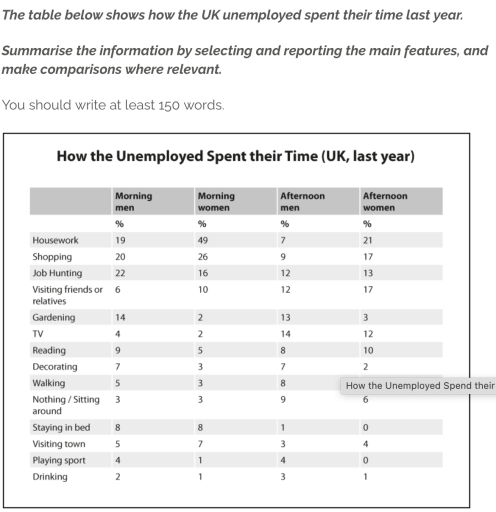
The table indicates how people who are out of work in the United Kingdom used their time in the prior year. The graph is divided into two portions of the day and 14 activities.
Overall, contrary to popular beliefs, unemployed people spent most of their time doing productive chores. They also spent little time on leisure activities like drinking and sports.
As seen from the graph, women dedicated a large part of their morning to housework and shopping, with 49 percent and 26 percent, respectively. These figures for men are significantly lower, spending just 19 percent of their morning hours on housework and 20 percent on shopping. Both genders expressed interest in job hunting, with males at 22 percent and females at 16 percent. The rest of the morning for both sexes was spent on other work, mainly productive hobbies like reading. Minimal time was spent on drinking, only 2 percent for men and 1 percent for women.
In the afternoon, both genders were more inclined to engage in entertainment. Though women still prioritised doing housework and shopping (21 percent and 17 percent), they also spent time on reading and watching television (12 and 10 percent). The same can be said for men, though they were more likely to do gardening (13 percent). Job hunting was still a large part of their day, with 12 and 13 percent for men and women,
Word Count: 232
