Our system will evaluate the answer based on this AI-generated description.
The image presents a table showing how unemployed people in the UK spent their time last year, listing different activities comparing morning and afternoon data between men and women. Morning activities for men include housework (1%), shopping (20%), job hunting (22%), visiting friends or relatives (6%), gardening (14%), TV watching (4%), reading (5%), decorating (7%), walking (5%), nothing/sitting around (3%), staying in bed (8%), visiting town (5%), playing sport (4%), and drinking (2%). Afternoon activities for men include housework (7%), shopping (12%), job hunting (9%), visiting friends or relatives (12%), gardening (3%), TV (14%), reading (8%), decorating (7%), walking (8%), nothing/sitting around (3%), staying in bed (1%), visiting town (4%), playing sport (1%), and drinking (3%). Morning activities for women include housework (19%), shopping (26%), job hunting (4%), visiting friends or relatives (10%), gardening (2%), TV (2%), reading (20%), decorating (3%), walking (5%), nothing/sitting around (3%), staying in bed (8%), visiting town (5%), playing sport (4%), and drinking (2%). Afternoon activities for women include housework (4%), shopping (17%), job hunting (13%), visiting friends or relatives (7%), gardening (1%), TV (12%), reading (10%), decorating (5%), walking (4%), nothing/sitting around (6%), staying in bed (0%), visiting town (4%), playing sport (0%), and drinking (1%).
Given the complexity of the image, the above description may not be entirely accurate.
Skyrocket your IELTS band score by 1-2 points in under a month with our premium plan!
Note: Both the topic and the answer were created by one of our users.
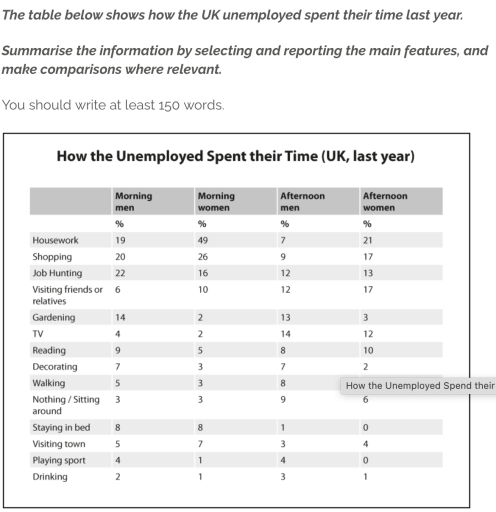
The provided table illustrates the percentages of unemployed people spending their time on various listed categories, classified by genders in the UK the previous year.
Looking from an overall perspective, it is readily apparent that women spent most of their time on household chores in both morning and afternoon. Additionally, job hunting was the activity requiring the largest amount of time of morning men whereas in the afternoon, men spent most of their time watching TV.
Looking first at morning trends, it is evident that women spent more time on housework than men did, with 49% and 19% respectively. 49% was also the largest figure for morning women. In the second highest rank, women spent 26% of their time on shopping while the figure for men in that category was 20%. Gardening, on the other hand, was more common for men than for women, with 14% and only 2% respectively. The same percentage can be witnessed in the group of staying in bed at 8% for both sexes.
Concerning afternoon trends, for women, housework was still remaining at its highest level at 21% whilst the figure in that category was only 7% for men. It is noteworthy that in the afternoon, men allocated most of their time to watching TV, with 14%. 12% was the proportion of unemployed women spending time on TV activity in the afternoon. Furthermore, the figure for afternoon women spending time on shopping was higher than that of afternoon men, with 17% and 9% respectively. Visiting friends or relatives was relatively popular for both genders, with 12% for men and 17% for women.
Word Count: 267
