🔥 Today Only: Save 30% on Premium — Offer Ends Soon! - Upgrade Now!
Table

Band 6+: The table below shows the attitudes to recycling of people in defferent age groups

Image for topic: The table below shows the attitudes to recycling of people in defferent age groups
Our system will evaluate the answer based on this AI-generated description.
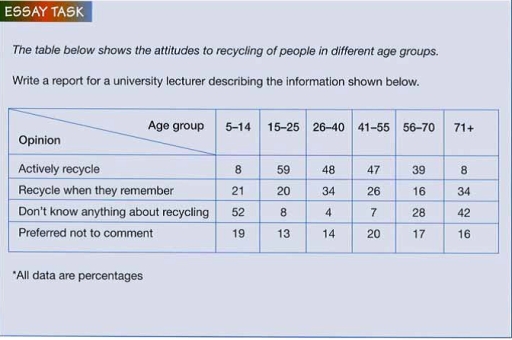
The image contains a table outlining recycling attitudes across age groups, with percentages distributed as follows: age group 5-14 shows 8% actively recycle, 21% recycle when they remember, 52% don’t know anything about recycling, 19% preferred not to comment; age group 15-25 shows 59% actively recycle, 20% recycle when they remember, 8% don’t know anything about recycling, 13% preferred not to comment; age group 26-40 shows 48% actively recycle, 34% recycle when they remember, 7% don’t know anything about recycling, 14% preferred not to comment; age group 41-55 shows 47% actively recycle, 26% recycle when they remember, 7% don’t know anything about recycling, 20% preferred not to comment; age group 56-70 shows 39% actively recycle, 16% recycle when they remember, 28% don’t know anything about recycling, 17% preferred not to comment; age group 71+ shows 8% actively recycle, 34% recycle when they remember, 42% don’t know anything about recycling, 16% preferred not to comment.
Given the complexity of the image, the above description may not be entirely accurate.
Note: Both the topic and the answer were created by one of our users.

The perspective of varied age groups of people about recycling has been shown in the table.

Overall, it can be seen that a large proportion of the children and elderly people did not know about recyling and they recycled the least on active bases. While, the young to middle aged group of people knew much and actively recycled the most.

The pople aged from 15-25 recycled the most with a percentage of 59 and the the age group from 25-55 recycled second to it of about 48 percent. The 7-14 and people above 70 recycled the least percentage of 8. the 26-40 year old peopled had the highest proportion of recycling when they remember equal to the people above 70.

42 percent of 70 plus years old people did not know antything about recyling which is the second to 7-14 age group which stands at 52 percent. An average of 18 to 19 percent people declined to answer the question on recycling.

Word Count: 162

Answers On The Same Topic:

The table below shows the attitudes to recycling of people in defferent age groups

The table shows information about the percentage of opinion of the people on recycling in different age. Overall,it is clear that the proportion of recycle when they remember expirienced a high figure on each age given the table while preffered not to commment maintained tha same percentage. Another interesting point is that,the figure for actively […]

The table below shows the attitudes to recycling of people in defferent age groups

The table represents the percentages of people engaged in recycling among varied age groups. Overall, those commited in recycling are mostly from teenagers and adults to elderly. In contrast, groups who unfamiliar and inactive in recycling are seen in children and elderly. Groups that seldomly recycle and expressing no view are relatively concentrated within a […]

The table below shows the attitudes to recycling of people in defferent age groups

The bar chart illustrates 4 different attitudes of people between 5 and more 71 years old. Overall, the lead number of people in type actively recycle in 15-25 age and second one the highest number of people do not know anything about recycing in 5-14 age, while recycle when they remember was significant one. The […]

The table below shows the attitudes to recycling of people in defferent age groups

The table illustrates the attitude of people in different age groups toward recycling. The survey was conducted among people from the following age groups: 5-14, 15-25, 26-40, 41-55, 56-70, and 70+. All data is represented as a percentage. Overall, children in the 5-14 age group mostly don’t know anything about recycling, while people aged 15-25 […]

See All

Other Topics:

The table below gives the information about the amount of tax collected (as % of GDP) in five countries for 4 years between 1975 and 2005

The table illustrates how much percent tax collected in five countries, namely Sweden, USA, Korea, Japan and Turkey between 1975 and 2005. Overall, we can see Sweden, which ranked firstly over all years, while Turkey ranked lastly with USA in last year. In Sweden, 46% and 47% tax collected in 1975 and 1985 years and […]

The chart below shows the percentage of passenger kilometers by different modes of transport in Shanghai.

The table shows the percentage of passenger kilometers traveled by various transportation types in Shanghai in 1996 and offers a forecast for 2030. Overall, while the bus was the most popular form of transport at the earlier date, the car is expected to be the most popular in 2030. First of all, although bus had […]

The table illustrates data on the underground railway networks in six different countries, categorized by time, size, and passengers per year.

The Table presents the data of Underground railway systems of several cities. Overall, London has the oldest and longest railway track, whereas Los Angeles has the most recently established system. In contrast, Tokyo records the highest annual passenger figures, while kyoto has both shortest route and lowest passenger number. London’s underground highway opened in 1863, […]

The table details the international tourist arrivals in millions in 8 countries in 2009 and 2010 and the changes (in percentages).

The table compares eight different nations in terms of their population figures in two separate years: 2009 and 2010. Overall, almost all countries recorded increasing figures to varying degrees, save for France, whose population number remained static at high levels over a year. Notably, Germany’s population, despite being consistently modest compared to other nations, registered […]

The table below gives information about the amount of water used in three different sectors in Egypt, Saudi Arabia, New Zealand, and Canada. Summarize the information by selecting and reporting the main features, and make comparisons where relevant.

The table illustrates information about the amount of water used in three sectors in Egypt, Saudi Arabia, New Zealand, and Canada. Overall, the highest proportion of water in Egypt is used for agriculture. Canada had the highest figure for industry, while the lowest proportion of water in Canada was used for agriculture. Looking at the […]

The tables below show the sources of funding for a public library system in 2010 and 2020, with projections for 2030, and the percentage of its annual budget allocated to four areas in those years.

The tables compare the three sources of funding for a public library system and the proportion of its yearly budget allocated to four types of expenditure in 2010 and 2020, followed by projections for 2030. Overall, the total annual budget for the library system increased over the first decade and is expected to continue rising […]

See All
We have detected unusual activity on your device.
Please verify your identity to continue.
Note: This verification step won't sign you in. If you have a premium account, please log in to access the service as usual.
Google/Gmail Verification
Or verify using Email/Code
We've sent a verification code to:
youremail@gmail.com (Not your email?)
Enter it below to complete the verification process.
Ensure your email address is correct, your inbox is not full, and you check your spam folder. If no email arrives, consider using an alternative email.
You will need a Premium plan to perform your action!
Note: If you already have a premium account, please log in to access our services as usual.

Plans & Pricing

Our mission is to make quality education accessible for everyone.
However, to keep our hardworking team running and this service alive, we genuinely need your support!
By opting for a premium plan, not only do you sustain us in achieving the mission, but you also unlock advanced features to enrich your learning experience.

Free

For learners who aren't pressed for time

What's included on Free
100+ Cambridge IELTS Tests
Instant IELTS Writing Task 1 & 2 Evaluation (2 times/month)
Instant IELTS Speaking Part 1, 2, & 3 Evaluation (2 times/month)
Instant IELTS Writing Task 1 & 2 Essay Generator (2 times/month)
500+ Dictation & Shadowing Exercises
100+ Pronunciation Exercises
Flashcards
Other Advanced Tools

Premium

For those serious about advancing their English proficiency, and for IELTS candidates aspiring to boost their band score by 1-2 points (especially in writing & speaking) in just 30 days or less

What's included on Premium
Save Your IELTS Test Progress & Analyze Mistakes By Question Type
Save Your Own Flashcard Sets & Use Them On Any Device
Unlock All Courses, IELTS Tests, Section & Part Practice
Unlimited AI Conversations
Unlimited AI Writing Enhancement Exercises
Unlimited IELTS Writing Task 1 & 2 Evaluation
Unlimited IELTS Speaking Part 1, 2, & 3 Evaluation
Checked Answers Will Not Be Published
Unlimited IELTS Writing Task 1 & 2 Essay Generator
Unlimited IELTS Speaking Part 1, 2, & 3 Sample Generator
Unlimited Usage Of Advanced Tools & AI Features
Priority Support within 24h (12-month plan only)

Due to the nature of our service and the provided free trials, payments are non-refundable.