Our system will evaluate the answer based on this AI-generated description.
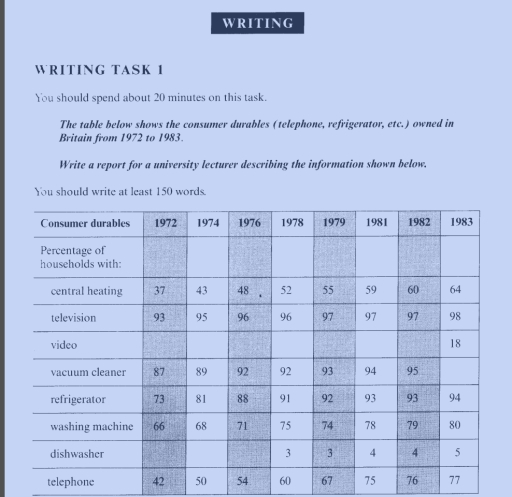
The image contains a table detailing the percentage of British households owning specific consumer durables from 1972 to 1983. Central heating ownership: 37% in 1972, 43% in 1974, 48% in 1976, 52% in 1978, 55% in 1979, 59% in 1981, 60% in 1982, 64% in 1983. Television ownership: 93% in 1972, 95% in 1974, 96% in 1976, 96% in 1978, 97% in 1979, 97% in 1981, 97% in 1982, 98% in 1983. Video ownership starts at 18% in 1983. Vacuum cleaner ownership: 87% in 1972, 89% in 1974, 92% in 1976, 92% in 1978, 93% in 1979, 94% in 1981, 95% in 1982 and 1983. Refrigerator ownership: 73% in 1972, 81% in 1974, 85% in 1976, 91% in 1978, 92% in 1979, 93% in 1981, and 94% in 1982 and 1983. Washing machine ownership: 66% in 1972, 68% in 1974, 71% in 1976, 75% in 1978, 74% in 1979, 78% in 1981, 79% in 1982, 80% in 1983. Dishwasher ownership: 3% in 1978, 3% in 1979 and 1981, 4% in 1982, 5% in 1983. Telephone ownership: 42% in 1972, 50% in 1974, 54% in 1976, 60% in 1978, 67% in 1979, 75% in 1981, 76% in 1982, 77% in 1983.
Given the complexity of the image, the above description may not be entirely accurate.
Skyrocket your IELTS band score by 1-2 points in under a month with our premium plan!
Note: Both the topic and the answer were created by one of our users.
The table illustrates changing ownership levels of consumer durables in British households between 1972 and 1983. Overall, most items showed increasing popularity, though adoption rates varied significantly.
Central heating experienced the most dramatic growth, rising from 37% to 64% of households. Telephones similarly surged from 42% to 77% ownership. Refrigerators became nearly universal, increasing from 73% to 94%.
Established appliances maintained consistently high ownership. Televisions remained ubiquitous throughout the period, growing slightly from 93% to 98%. Vacuum cleaners followed a similar pattern, rising from 87% to 95% by 1982. Washing machines showed steady growth from 66% to 80%.
Luxury items gained limited traction. Dishwashers, appearing in 1978 at 3%, reached just 5% by 1983. Video recorders, first measured in 1983, stood at 18% penetration.
The data reveals clear patterns: essential appliances achieved near-universal adoption, while newer or more expensive technologies spread more slowly. Central heating and telephones showed the most significant increases, reflecting improving living standards. Basic household items like refrigerators and vacuum cleaners approached complete market saturation, whereas discretionary purchases like dishwashers remained niche products during this period.
Word Count: 179
