Our system will evaluate the answer based on this AI-generated description.
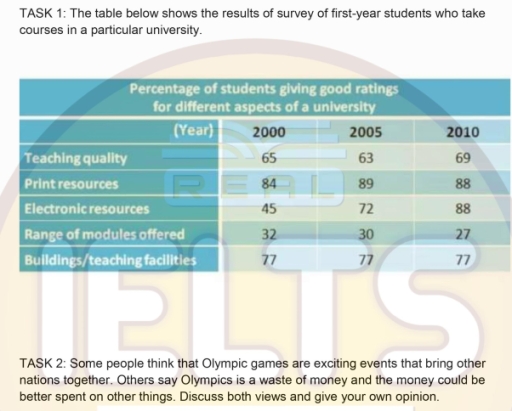
The image contains two separate tasks; TASK 1 displays a table listing percentages of first-year students giving good ratings to various university aspects for three different years: 2000, 2005, and 2010. Teaching quality received 65% in 2000, 75% in 2005, and 69% in 2010. Print resources had 84% in 2000, 89% in 2005, and 88% in 2010. Electronic resources began at 45% in 2000, jumped to 72% in 2005, and reached 88% in 2010. The range of modules offered was rated 32% in 2000, rose to 60% in 2005, and held at 77% in 2010. Lastly, buildings/teaching facilities were consistently at 77% in both 2000 and 2005, but experienced a 6% drop to 71% in 2010. TASK 2 presents a text prompt discussing varying opinions on the Olympic games, suggesting it can either be an exciting event that unites nations or a waste of money that could be allocated elsewhere; the task requires discussing both views and providing a personal opinion.
Given the complexity of the image, the above description may not be entirely accurate.
Skyrocket your IELTS band score by 1-2 points in under a month with our premium plan!
Note: Both the topic and the answer were created by one of our users.
Contained in the table is the information pertaining to the consequence of the survey of courses, which was recorded in the percentage of first-year students take in a specific university during the year 2000, 2005 and 2010. The units are measured in per cent per area.
Overall, the rate of teaching quality, print and electronic resources saw an increase while the bracket of modules offered decreased and facilities remained the same. Additionally, print resources had the biggest percentage of students giving good ratings despite the least proportion of modules offered.
Looking at the proportion of teaching quality, it experienced a downward trend in the first five years, from 65% to 63%, before climbing up to 69% in 2010. By contrast, print resources started at 84% in 2000 then increased by 5% five years later and dropped to 88% after that.
Moving on to the electronic resources percentage, it recorded an upward trend from 45% in 2000 to nearly double at the end of the time scale. However, the range of modules offered saw a decline from 32% to 27% after ten years. Concurrently, the teaching facilities proportion remained the same at 77% during the timeframe.
Word Count: 195
