🔥 Today Only: Save 30% on Premium — Offer Ends Soon! - Upgrade Now!
Table

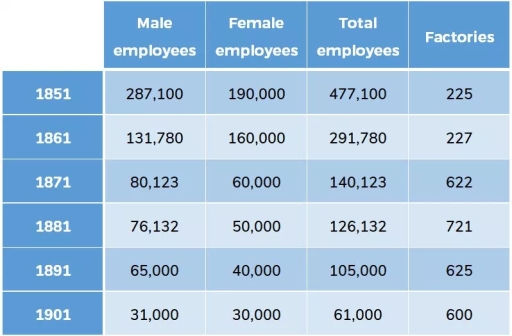
Band 8+: The table describes the number of employees and factories in England and Wales from 1851 to 1901.

Image for topic: The table describes the number of employees and factories in England and Wales from 1851 to 1901.
Our system will evaluate the answer based on this AI-generated description.
The image is a table with five rows and five columns. The first column headers are "Male employees," "Female employees," "Total employees," and "Factories." The rows are labeled with years 1851 to 1901 in increments of 10 years. In 1851, male employees were 287,100, female employees were 190,000, total employees were 477,100, and there were 225 factories. In 1861, male employees dropped to 131,780, female employees to 160,000, total employees to 291,780, and factories increased to 227. By 1871, male employees decreased to 80,123, female employees to 60,000, total to 140,123, and a significant jump in factories to 622. In 1881, male employees were 76,132, female employees at 50,000, total employees at 126,132, and factories rose to 721. By 1891, male employees fell to 65,000, female to 40,000, total to 105,000, and factories dropped to 625. Finally, in 1901, male employees were 31,000, female employees at 30,000, total employees at 61,000, and factories reduced to 600.
Given the complexity of the image, the above description may not be entirely accurate.
Note: Both the topic and the answer were created by one of our users.

The table presents information about the workforce involved in silk production across two countries, England and Wales, over a span of 50 years beginning in 1851.

It is evident that the total number of silk workers in both countries declined during this period, with a significantly greater number of women employed compared to men in the industry. Furthermore, the number of silk manufacturing factories increased over the 50 years, despite experiencing some fluctuations.

In 1851, the silk workforce reached its peak, comprising 130,750 employees, including 76,786 females and approximately 54,000 males. Conversely, the number of silk factories was at its lowest in the same year, totaling only 272. However, by 1861, this number had nearly tripled to 761, while the total number of employees witnessed a substantial decline of over 20,000 individuals.

Throughout the following 40 years, both the number of female and male workers gradually decreased, ultimately falling to 25,567 and 13,375, respectively. This decline contributed to a total workforce of 38,942 employees by 1901. During the same period, the count of silk factories also experienced a gradual decrease, dropping from 761 in 1861 to 623 in 1901.

Word Count: 189

Answers On The Same Topic:

The table describes the number of employees and factories in England and Wales from 1851 to 1901.

The table illustrates the workforce dynamics and factory numbers within the silk production industry in England and Wales over a 50-year span from 1851 to 1901. It is apparent that the total employee count experienced a marked decline throughout the period, while the distribution of male and female workers shifted sharply. Concurrently, the number of […]

The table describes the number of employees and factories in England and Wales from 1851 to 1901.

The table illustrates how the number of factories and workers changed in England and Wales during a 50-year period, commencing from 1851. At first glance, it can be seen that while the factories experienced an uptrend, the opposite pattern was true for both male and female employees. Notably, the number of male laborers was considerably […]

The table describes the number of employees and factories in England and Wales from 1851 to 1901.

The table illustrates how the number of factories and workers changed in England and Wales in the period of 50 years, commencing from 1851. At a first glance, it can be seen that while the factories experienced an uptrend, the opposite pattern was true for both male and female employees. Notably, the number of male […]

The table describes the number of employees and factories in England and Wales from 1851 to 1901.

The given table represents the amount of employees and factories in England and Wales every ten years from 1851 to 1901. Overall, the numbers of staff, both male and female, reduced during that period, while the total number of industries increased. We can see that the sum of workers reached its peak in 1851 with […]

The table describes the number of employees and factories in England and Wales from 1851 to 1901.

The table provides a detailed breakdown of the number of factories and employees in Wales and England over a 50-year period, from 1851 to 1901. In summary, while the employment figures exhibited a significant decline, the number of factories rose significantly, even though their numbers declined considerably in the last two decades. In detail, the […]

See All

Other Topics:

The diagram below shows the changes in the number of people who rely on fuel from organic sources from 2004 to 2030. Summarise the information by selecting and reporting the main features, and make comparisons where relevant.

The data displays the fluctuations in the number of individuals relying on biofuel between 2004 and 2030 in different regions of the world. Despite the fact that the overall reliance on the fuel increased, not every country faced the same fate, especially China, while Rest of Latin america faced a decline as well, it was […]

The tables below give information about the amount of exports (millions of tonnes) moving through Rotterdam port in Holland to various global destinations in 2002 and 2012; and also, the % rates of tax imposed on these exports by the receiving countries. Write a report for a university lecturer describing the information shown below, and make comparisons where relevant.

This picture illustrates percent and number of USA,Europe,China and other countries which were exported by destination,in addition rates of taxs during 2002 to 2012.Export was in Holland to different miles to these. First of all,the first table shows millions of tonnes to various country.In 2002 the biggest amount of exports was in Europe,it is 6900.And […]

The table below shows the distribution of students at uk universities by mode of study and gender.

The table charts illustrate how many students were distributed to UK universities in terms of genders and kind of study from 1996/97 to 2009/10. Overall, full-time enrollments for both genders rose steadily over the period, while part-time figures showed fluctuation, with male part-time numbers varying and female part-time peaking in 2005/06 before falling slightly by […]

The table below shows the distribution of students at uk universities by mode of study and gender.

The table charts illustrate how many students were distributed to UK universities in terms of genders and kind of study from 1996/97 to 2009/10. Overall, full-time enrollments for both genders rose steadily over the period, while part-time figures showed fluctuation, with male part-time numbers varying and female part-time peaking in 2005/06 before falling slightly by […]

The table below shows population figure for four countries for 2003 and projected figure for 2025 and 2050

The table represents the population figure in millions for four countries for 2003 and projected figure for 2025 and 2025. Here , Indonesia is slight differnet and has the higest Population figure others are overall same. If we look at Argentia and Republic of korea overall every country had a popultion range between 30-50 , […]

The tables below give information about the cónumotion and production of potatoes in different world regions in 2006

The tables below give information about the consumption and production of potatoes in five continents in 2006. Overall, the highest requires for potatoes experienced in Europe, whereas the lowest outcome was Africa. Meanwhile, the manufacturing of potatoes was popular in Asia. However, the lowest result show in Africa and South and Central America. Focusing on […]

See All
We have detected unusual activity on your device.
Please verify your identity to continue.
Note: This verification step won't sign you in. If you have a premium account, please log in to access the service as usual.
Google/Gmail Verification
Or verify using Email/Code
We've sent a verification code to:
youremail@gmail.com (Not your email?)
Enter it below to complete the verification process.
Ensure your email address is correct, your inbox is not full, and you check your spam folder. If no email arrives, consider using an alternative email.
You will need a Premium plan to perform your action!
Note: If you already have a premium account, please log in to access our services as usual.

Plans & Pricing

Our mission is to make quality education accessible for everyone.
However, to keep our hardworking team running and this service alive, we genuinely need your support!
By opting for a premium plan, not only do you sustain us in achieving the mission, but you also unlock advanced features to enrich your learning experience.

Free

For learners who aren't pressed for time

What's included on Free
100+ Cambridge IELTS Tests
Instant IELTS Writing Task 1 & 2 Evaluation (2 times/month)
Instant IELTS Speaking Part 1, 2, & 3 Evaluation (5 times/month)
Instant IELTS Writing Task 1 & 2 Essay Generator (2 times/month)
500+ Dictation & Shadowing Exercises
100+ Pronunciation Exercises
Flashcards
Other Advanced Tools

Premium

For those serious about advancing their English proficiency, and for IELTS candidates aspiring to boost their band score by 1-2 points (especially in writing & speaking) in just 30 days or less

What's included on Premium
Save Your IELTS Test Progress
Unlock All Courses & IELTS Tests
Unlimited AI Conversations
Unlimited AI Writing Enhancement Exercises
Unlimited IELTS Writing Task 1 & 2 Evaluation
Unlimited IELTS Speaking Part 1, 2, & 3 Evaluation
Checked Answers Will Not Be Published
Unlimited IELTS Writing Task 1 & 2 Essay Generator
Unlimited IELTS Speaking Part 1, 2, & 3 Sample Generator
Unlimited Usage Of Advanced Tools
Priority Support within 24h (12-month plan only)

Due to the nature of our service and the provided free trials, payments are non-refundable.
Nếu bạn là người Việt Nam và không có hoặc không muốn trả bằng credit/debit cards, bạn có thể thanh toán bằng phương thức chuyển khoản:


Chọn gói:
419,000₫ 277,000 ₫ cho gói 1 tháng (chỉ 9,233₫/ngày)
1,239,000₫ 597,000 ₫ cho gói 3 tháng (chỉ 6,633₫/ngày)
2,469,000₫ 1,027,000 ₫ cho gói 6 tháng (chỉ 5,706₫/ngày)
4,929,000₫ 1,417,000 ₫ cho gói 12 tháng (chỉ 3,936₫/ngày)


Sau khi chuyển khoản, vui lòng đợi trình duyệt tự động điều hướng bạn trở lại Engnovate và bạn sẽ ngay lập tức nhận được mã kích hoạt tài khoản premium.
Nếu có lỗi xảy ra, bạn có thể liên hệ với team thông qua một trong các phương thức: email đến helloengnovate@gmail.com hoặc nhắn tin qua facebook.com/engnovate.
Vì toàn bộ công cụ trên website đều có thể sử dụng thử miễn phí, Engnovate không hỗ trợ hoàn tiền.