Our system will evaluate the answer based on this AI-generated description.
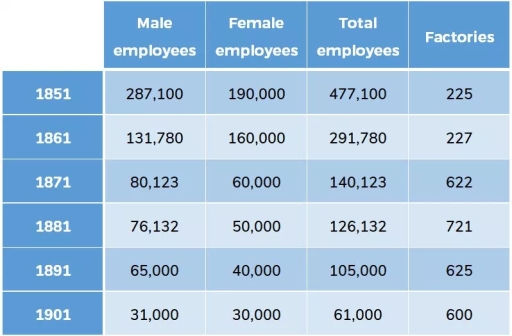
The image is a table with five rows and five columns. The first column headers are "Male employees," "Female employees," "Total employees," and "Factories." The rows are labeled with years 1851 to 1901 in increments of 10 years. In 1851, male employees were 287,100, female employees were 190,000, total employees were 477,100, and there were 225 factories. In 1861, male employees dropped to 131,780, female employees to 160,000, total employees to 291,780, and factories increased to 227. By 1871, male employees decreased to 80,123, female employees to 60,000, total to 140,123, and a significant jump in factories to 622. In 1881, male employees were 76,132, female employees at 50,000, total employees at 126,132, and factories rose to 721. By 1891, male employees fell to 65,000, female to 40,000, total to 105,000, and factories dropped to 625. Finally, in 1901, male employees were 31,000, female employees at 30,000, total employees at 61,000, and factories reduced to 600.
Given the complexity of the image, the above description may not be entirely accurate.
Skyrocket your IELTS band score by 1-2 points in under a month with our premium plan!
Note: Both the topic and the answer were created by one of our users.
The given table represents the amount of employees and factories in England and Wales every ten years from 1851 to 1901. Overall, the numbers of staff, both male and female, reduced during that period, while the total number of industries increased.
We can see that the sum of workers reached its peak in 1851 with totals of 477,100 people, with a distribution of 287,100 men and 190,000 women, whereas mills might not have been popular yet with only 225 in that era; each of them hired approximately 2,120 staff. Then, the numbers declined by around 70% to 140,123 employees, with 80,123 male and 60,000 female in the next two decades, while the volume of factories skyrocketed to 622; each contained 225 laborers, which was almost 90% less than in 1851.
In following decades, the sum of staff still slightly fell until in 1901 it reached its lowest with only 61,000 employees and almost an equal ratio of men and women workers, with 31,000 and 30,000 respectively. It is worth noticing that the number of factories fluctuated between 1871 and 1901, beginning with 622 in 1871, then climbing to its highest with 721 in 1881, before finally falling back to 600 in 1901, which was also the lowest number of employees in every mill with only 1,000 staff.
Word Count: 217
