Our system will evaluate the answer based on this AI-generated description.
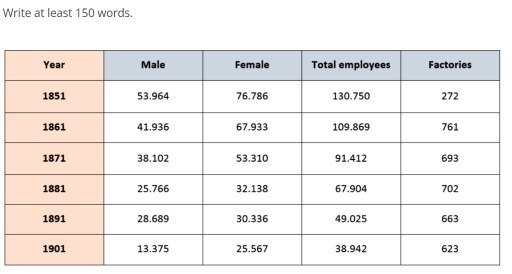
The image consists of a table with 6 columns and 5 rows. The first column indicates the years: 1851, 1861, 1871, 1881, 1891, and 1901. The second and third columns indicate the number of male and female employees, respectively. The fourth column indicates the total number of employees, and the fifth column indicates the number of factories.
In 1851, there were 53,964 male employees, 76,786 female employees, 130,750 total employees, and 272 factories. In 1861, there were 41,936 male employees, 67,933 female employees, 109,869 total employees, and 761 factories. In 1871, there were 38,102 male employees, 53,310 female employees, 91,412 total employees, and 693 factories. In 1881, there were 25,766 male employees, 32,138 female employees, 67,904 total employees, and 702 factories. In 1891, there were 28,689 male employees, 30,336 female employees, 49,025 total employees, and 663 factories. In 1901, there were 13,375 male employees, 25,567 female employees, 38,942 total employees, and 623 factories.
The table shows a decrease in the number of employees and a decrease in the number of factories over the 50-year period. The number of male employees decreased by 40,589, while the number of female employees decreased by 51,219. The total number of employees decreased by 91,808, and the number of factories decreased by 349. The trend indicates a steady decrease in both male and female employees, total employees, and factories across each decade.
Given the complexity of the image, the above description may not be entirely accurate.
Skyrocket your IELTS band score by 1-2 points in under a month with our premium plan!
Note: Both the topic and the answer were created by one of our users.
The table shows the number of workers of both genders and factories that manufactured silk in England and Wales from 1851 to 1901.
Overall, there was a stable decreasing trend which could be observed in the figures for female workers and total employees, while the other two sectors underwent some remarkable fluctuations during a 50-year period.
In 1851, around 53,964 men and 76,786 women were employed to work in more than 270 silk factories, resulting in the total employees standing at 130,750 people. Over the next 10 years, while the number of factories in these areas significantly soared to 761, the levels for working laborers in this industry considerably dropped by roughly 20,000 people (41,936 men and 67,933 women). The similar downward trend could be observed in the year 1871, when there were approximately 91,412 individuals engaging in just over 630 silk factories.
In the period from 1881 to 1891, the gap between the quantities of male and female workers participating in this occupation gradually narrowed. Whereas the level for male individuals experienced a slight growth from 25,766 in 1881 to 28,699 in 1891, the other three sectors witnessed a sustainable reduction, reaching just over 49,000 people working in 663 factories at the same time. Eventually, the year 1901 exhibited a similar decreased pattern in the levels for the four examined categories, as there were only around 39,000 workers, including 13,375 men and 25,567 women employed in 623 factories.
Word Count: 239
