Our system will evaluate the answer based on this AI-generated description.
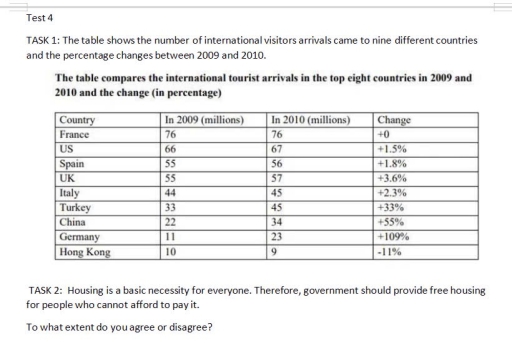
The image presents a table detailing international tourist arrivals in millions and percentage changes from 2009 to 2010 across nine countries: France had 76 million visitors in both years with a 0% change; US had 66 million in 2009, rising to 67 million in 2010 with a +1.5% change; Spain had 55 million in 2009 and 56 million in 2010, marking a +1.8% change; UK had 55 million in 2009 and 57 million in 2010 with a +3.6% change; Italy registered 44 million in 2009 and 45 million in 2010, reflecting a +2.3% change; Turkey had 33 million in 2009 and 45 million in 2010, indicating a +33% change; China saw an increase from 22 million in 2009 to 34 million in 2010, showing a +55% change; Germany increased from 11 million in 2009 to 23 million in 2010, with a +109% change; and Hong Kong had 10 million in 2009, dropping to 9 million in 2010, which is a -11% change.
Given the complexity of the image, the above description may not be entirely accurate.
Skyrocket your IELTS band score by 1-2 points in under a month with our premium plan!
Note: Both the topic and the answer were created by one of our users.
The table compares the number of international tourists arriving in 9 countries in 2009 and 2010.
Overall, while US, Spain, UK, and Italy maintained as the countries with the least noticeable changes over the period, Turkey, China and Germany exhibited the most pronounced growth. In contrast, France’s figures remained unchanged and Hong Kong showed little decrease.
Among the countries that showed sharp growth in international tourist arrivals, Turkey and China experienced remarkable increases, rising from 33 million and 22 million in 2009 to 45 million and 33 million in 2010, representing growth rates of 55% and 109%, respectively. Germany followed, with a small but noticeable increase from 11 million to 23 million over the same period, representing a 105% rise.
In terms of remaining countries, France stood out at 76 million showing no variation across both years analyzed. Meanwhile, the US, Spain, the UK, and Italy experienced only slight changes in their numbers, with increases of just 1-2 million. Among all the countries, Hong Kong emerges as the least significant, showing decrease from 10 million to 9 million, and experinencing change to -11%.
Word Count: 183
