Our system will evaluate the answer based on this AI-generated description.
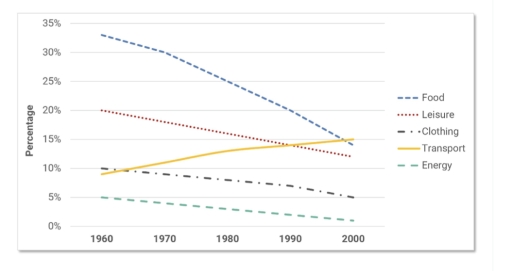
The image contains a line graph with no title, displaying trends over time from 1960 to 2000 in five different categories: Food, Leisure, Clothing, Transport, and Energy. The y-axis shows percentages ranging from 0% to 35%, increasing by 5% increments, while the x-axis lists the years in 10-year increments. Data points at 1960 show Food roughly at 33%, Leisure at 12%, Clothing at 13%, Transport at 9%, and Energy at 6%. By 1970, Food decreased to 31%, Leisure increased to 14%, Clothing decreased to 12%, Transport increased to 11%, and Energy remained at 6%. In 1980, Food continued to drop to 27%, Leisure rose to 16%, Clothing fell to 11%, Transport continued to rise to 13%, and Energy stayed at 6%. By 1990, Food dropped further to 23%, Leisure went up to 18%, Clothing declined to 10%, Transport rose to 14%, and Energy stayed consistent at 6%. Finally, in 2000, Food decreased to 20%, Leisure increased to 21%, Clothing decreased to 9%, Transport increased to 15%, and Energy continued at 6%. No data points for individual years between the decades are provided. The lines for Food, Clothing, and Energy have negative slopes, while the lines for Leisure and Transport have positive slopes.
Given the complexity of the image, the above description may not be entirely accurate.
Skyrocket your IELTS band score by 1-2 points in under a month with our premium plan!
Note: Both the topic and the answer were created by one of our users.
The diagram gives information about the percentage of five spending fields by certain European countries over a 40-year period from 1960 to 2000. Overall, while the figures for food, leisure, transportation and energy decreased to varying degrees, the reverse was true for clothing. It is also clear that the food and leisure categories showed much bigger percentages at the beginning of the period.
The proportions of food and leisure showed higher expenditure. In 1960, the figure for the former was 32%, and the latter was 20%, and this was followed by a staggering fall to under 14% and 13%, respectively. Despite dropping considerably over the years, the proportions were higher even in the final year when compared to the others.
The proportions of clothing and transport started at almost the same percentage—9% and 10%, respectively. Clothing, on the other hand, bucked the trend. In 1980, it rose to 13%, and then it kept increasing, and in 2000, it reached 15%. While European transport allocations experienced a drawback, and in the last year it decreased to 5%. Similarly, the proportion of energy dropped dramatically and hit a chart low of a mere 1% in 2000.
Word Count: 194
