Our system will evaluate the answer based on this AI-generated description.
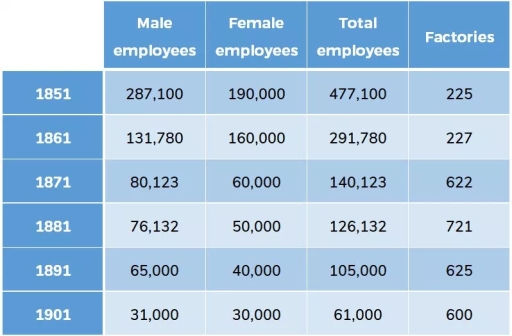
The image is a table with five rows and five columns. The first column headers are "Male employees," "Female employees," "Total employees," and "Factories." The rows are labeled with years 1851 to 1901 in increments of 10 years. In 1851, male employees were 287,100, female employees were 190,000, total employees were 477,100, and there were 225 factories. In 1861, male employees dropped to 131,780, female employees to 160,000, total employees to 291,780, and factories increased to 227. By 1871, male employees decreased to 80,123, female employees to 60,000, total to 140,123, and a significant jump in factories to 622. In 1881, male employees were 76,132, female employees at 50,000, total employees at 126,132, and factories rose to 721. By 1891, male employees fell to 65,000, female to 40,000, total to 105,000, and factories dropped to 625. Finally, in 1901, male employees were 31,000, female employees at 30,000, total employees at 61,000, and factories reduced to 600.
Given the complexity of the image, the above description may not be entirely accurate.
Skyrocket your IELTS band score by 1-2 points in under a month with our premium plan!
Note: Both the topic and the answer were created by one of our users.
The table illustrates the change in quantity of employees working at factories from 1851 to 1901, as well as the number of factories itself. It is clear that the number of factories producing silk considerably increased through the described period. Simultaneously the total number of employees decreased quite dramatically. It is quite oblivious that the number of women exceeded the number of men employed at the factories
In 1951 the number of employees stated at 130. 750 with just 272 factories to work at. The figures for female involved in labor exceed the number of males by more than 23 000 employees. The total figured for employees decreased through the years. On the contrary the number of factories soared by more than three times to peak at 1861 with 761 factories.
Over the next two decades fewer peopled used to be employed at factories, which diminished for more than twice. At the same time, the number of men and women employed almost evened out in 1891. The were less factories to work at.
From 1891 to 1901 the total number on employees continued to fall down, with less males involved in factories.
Word Count: 192
