
Tidal Power - IELTS Reading Answers & Explanations
From Cambridge IELTS 09 Academic Reading Test 3 · Part 2 · Questions 14–26
Reading Passage
You should spend about 20 minutes on Questions 14-26, which are based on Reading Passage 2 below.
Tidal Power
Undersea turbines which produce electricity from the tides are set to become an important source of renewable energy for Britain. It is still too early to predict the extent of the impact they may have, but all the signs are that they will play a significant role in the future
A Operating on the same principle as wind turbines, the power in sea turbines comes from tidal currents which turn blades similar to ships' propellers, but, unlike wind, the tides are predictable and the power input is constant. The technology raises the prospect of Britain becoming self-sufficient in renewable energy and drastically reducing its carbon dioxide emissions. If tide, wind and wave power are all developed, Britain would be able to close gas, coal and nuclear power plants and export renewable power to other parts of Europe. Unlike wind power, which Britain originally developed and then abandoned for 20 years allowing the Dutch to make it a major industry, undersea turbines could become a big export earner to island nations such as Japan and New Zealand.
B Tidal sites have already been identified that will produce one sixth or more of the UK's power - and at prices competitive with modern gas turbines and undercutting those of the already ailing nuclear industry. One site alone, the Pentland Firth, between Orkney and mainland Scotland, could produce 10% of the country's electricity with banks of turbines under the sea, and another at Alderney in the Channel Islands three times the 1,200 megawatts of Britain's largest and newest nuclear plant, Sizewell B, in Suffolk. Other sites identified include the Bristol Channel and the west coast of Scotland, particularly the channel between Campbeltown and Northern Ireland.
C Work on designs for the new turbine blades and sites are well advanced at the University of Southampton's sustainable energy research group. The first station is expected to be installed off Lynmouth in Devon shortly to test the technology in a venture jointly funded by the department of Trade and Industry and the European Union. AbuBakr Bahaj, in charge of the Southampton research, said: 'The prospects for energy from tidal currents are far better than from wind because the flows of water are predictable and constant. The technology for dealing with the hostile saline environment under the sea has been developed in the North Sea oil industry and much is already known about turbine blade design, because of wind power and ship propellers. There are a few technical difficulties, but I believe in the next five to ten years we will be installing commercial marine turbine farms.' Southampton has been awarded £215,000 over three years to develop the turbines and is working with Marine Current Turbines, a subsidiary of IT power, on the Lynmouth project. EU research has now identified 106 potential sites for tidal power, 80% round the coasts of Britain. The best sites are between islands or around heavily indented coasts where there are strong tidal currents.
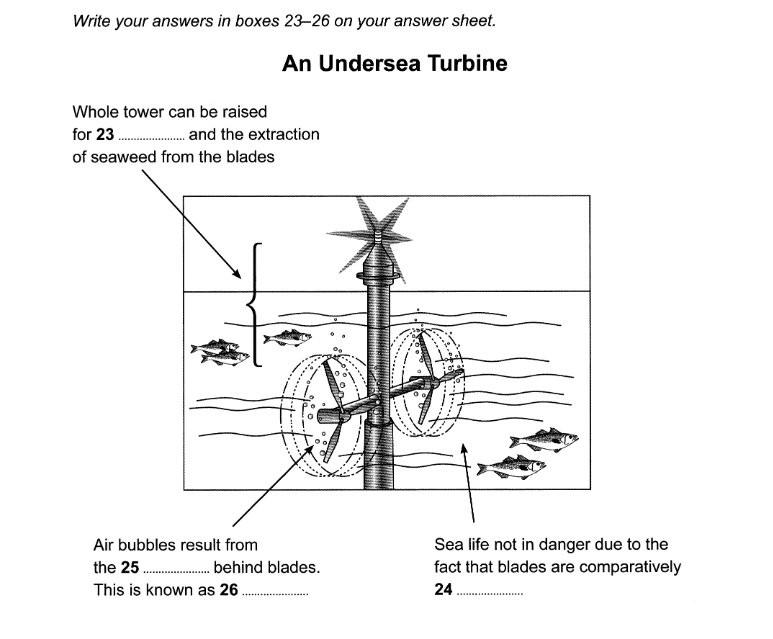
D A marine turbine blade needs to be only one third of the size of a wind generator to produce three times as much power. The blades will be about 20 metres in diameter, so around 30 metres of water is required. Unlike wind power, there are unlikely to be environmental objections. Fish and other creatures are thought unlikely to be at risk from the relatively slow-turning blades. Each turbine will be mounted on a tower which will connect to the national power supply grid via underwater cables. The towers will stick out of the water and be lit, to warn shipping, and also be designed to be lifted out of the water for maintenance and to clean seaweed from the blades.
E Dr Bahaj has done most work on the Alderney site, where there are powerful currents. The single undersea turbine farm would produce far more power than needed for the Channel Islands and most would be fed into the French Grid and be re-imported into Britain via the cable under the Channel.
F One technical difficulty is cavitation, where low pressure behind a turning blade causes air bubbles. These can cause vibration and damage the blades of the turbines. Dr Bahaj said: 'We have to test a number of blade types to avoid this happening or at least make sure it does not damage the turbines or reduce performance. Another slight concern is submerged debris floating into the blades. So far we do not know how much of a problem it might be. We will have to make the turbines robust because the sea is a hostile environment, but all the signs that we can do it are good.'
Questions
Questions 14–17 Matching Information
Reading Passage 2 has six paragraphs, A-F.
Which paragraph contains the following information?
NB You may use any letter more than once.
Questions 18–22 Five Choices
Choose FIVE letters, A-J.
Questions 23–26 Diagram Labeling
Label the diagram below.
Choose NO MORE THAN TWO WORDS from the passage for each answer.
Answers & Explanations Summary
| # | Answer | Evidence | Explanation |
|---|---|---|---|
| Q14 | C | The first station is expected to be installed off Lynmouth in Devon shortly to test the technology in a venture jointly funded by the department of Trade and Industry and the European Union | Excerpt/Passage Explanation: The passage explains that the first power building will soon be placed in the sea near Lynmouth in Devon so that experts can check if the technology works as planned. Answer Explanation: The answer is paragraph C because it names the specific place where the very first experimental turbine will be put into the water to see if it works. Reason For Correctness: The correct answer is C because this paragraph explicitly mentions 'Lynmouth in Devon' as the location for the 'first station' (which means the first test site) to be 'installed' to 'test the technology.' While other paragraphs like B and E mention other potential locations for making power, paragraph C is the only one that identifies the location used for the initial testing phase. |
| Q15 | E | The single undersea turbine farm would produce far more power than needed for the Channel Islands and most would be fed into the French Grid and be re-imported into Britain via the cable under the Channel | Excerpt/Passage Explanation: The passage explains that much of the electricity from this one underwater power station will be sent to France's electricity system and then brought back into Britain through a long wire under the sea. Answer Explanation: The answer is Paragraph E. Reason For Correctness: The correct answer is Paragraph E because it describes a specific process for getting electricity into Britain from a site located elsewhere. The text explains that power generated at the Alderney site would be sent to the French power network and then 're-imported' (which means brought back) into Britain using a 'cable' under the English Channel. This matches the idea of finding a way to bring power back to the country from a production site. |
| Q16 | A | Unlike wind power, which Britain originally developed and then abandoned for 20 years allowing the Dutch to make it a major industry, undersea turbines could become a big export earner to island nations such as Japan and New Zealand | Excerpt/Passage Explanation: The passage explains that Britain was the first to work on wind power technology. However, they stopped using it for 20 years before other countries like the Netherlands turned it into a big business. This proves they had a past attempt at a different energy type. Answer Explanation: The answer is paragraph A because it mentions a past time when Britain tried many years ago to use wind energy as a different way to get power. Reason For Correctness: The correct answer is A because it describes how Britain first started (originally developed) wind power but then stopped (abandoned) it for 20 years. Wind power is an 'alternative source of energy' because it is renewable and different from traditional sources like coal. The word 'originally' refers to a 'previous' or past time, and 'abandoned' shows they stopped their earlier attempt for a long time. |
| Q17 | C | The technology for dealing with the hostile saline environment under the sea has been developed in the North Sea oil industry and much is already known about turbine blade design, because of wind power and ship propellers | Excerpt/Passage Explanation: The passage explains that people already have the skills to work in the salty ocean and design turbine parts because they have done similar work for the oil industry, wind power, and ships. Answer Explanation: The answer C means that the third paragraph of the reading passage contains the information about using technology from a different business field. Reason For Correctness: The correct answer is C because this paragraph explains that the knowledge needed to build these machines under the sea was already created by another business: the "North Sea oil industry." It also says that "wind power" and ships gave them information about how to design the blades. This shows that they are taking ideas and tools from other industries and applying them to tidal power. |
| Q18 | — | — | |
| Q19 | — | — | |
| Q20 | — | — | |
| Q21 | — | — | |
| Q22 | A / D / E / F / J | unlike wind, the tides are predictable and the power input is constant drastically reducing its carbon dioxide emissions Britain would be able to close gas, coal and nuclear power plants undersea turbines could become a big export earner The best sites are between islands or around heavily indented coasts where there are strong tidal currents |
Excerpt/Passage Explanation: The passage explains that tidal energy is steady and easier to rely on than wind. It notes that using this energy helps stop the use of dirty power plants and lowers harmful air emissions. It also suggests that selling this technology to other countries can make money and that the best places to build these turbines are near specific coastal landforms like islands or narrow channels. Answer Explanation: The answer identifies five points the writer makes about tidal power: it is more dependable than wind, it can lead to closing old power plants, it lowers air pollution, it can earn money for the country, and it is most effective near specific coastal shapes. Reason For Correctness: The correct answer consists of five claims directly supported by the text. Choice A is correct because the writer describes tides as 'predictable' and 'constant,' unlike wind. Choice D is correct because the passage mentions Britain could 'close' various existing power plants. Choice E is correct as tidal power 'drastically' reduces carbon dioxide, a major air pollutant. Choice F is correct because the technology can be a 'big export earner,' increasing national wealth. Choice J is correct as the text specifies that the 'best sites' for this energy are near islands or 'heavily indented coasts.' |
| Q23 | maintenance | The towers will stick out of the water and be lit, to warn shipping, and also be designed to be lifted out of the water for maintenance and to clean seaweed from the blades | Excerpt/Passage Explanation: The passage explains that the towers can be pulled up out of the ocean so that people can fix them and clean the parts. Answer Explanation: The answer "maintenance" means the work of checking, fixing, or cleaning a machine to keep it working correctly. Reason For Correctness: The correct answer is "maintenance" because Paragraph D explains the practical design of the turbine towers. It mentions that these structures are built so they can be pulled up out of the sea. The purpose of lifting them is to allow for repairs or "maintenance" and to wash away seaweed that grows on the blades. |
| Q24 | slow turning / slow | Fish and other creatures are thought unlikely to be at risk from the relatively slow-turning blades | Excerpt/Passage Explanation: The passage says that sea animals will probably not be hurt because the parts of the machine that spin move slowly. Answer Explanation: The answer describes the speed of the turbine blades, which do not move very fast. Reason For Correctness: The correct answer is based on paragraph D, which addresses the environmental impact of tidal turbines. It notes that fish and other sea animals are not expected to be in danger because the blades move at a low speed. The term 'slow-turning' is used in the passage to describe this movement, ensuring the safety of sea life. |
| Q25 | low pressure | One technical difficulty is cavitation, where low pressure behind a turning blade causes air bubbles | Excerpt/Passage Explanation: The passage says that when the water behind a moving blade is not pushing hard enough, it creates little bubbles of air. Answer Explanation: The answer means that the force or weight of the water pushing against something is not very strong. Reason For Correctness: The correct answer explains the cause of 'cavitation', which is a technical problem mentioned in the text. According to the passage, this issue happens when 'low pressure' occurs behind a spinning blade, which then creates air bubbles that can damage the machine. |
| Q26 | cavitation | One technical difficulty is cavitation, where low pressure behind a turning blade causes air bubbles. These can cause vibration and damage the blades of the turbines | Excerpt/Passage Explanation: The passage explains that cavitation is a problem that happens when a blade turns. It creates low pressure and air bubbles. These bubbles make the metal shake and can break the blades. Answer Explanation: The answer is a technical term for a specific problem where air bubbles form behind a moving part in water. Reason For Correctness: The correct answer is identified in Section F as a 'technical difficulty.' The passage explains that this phenomenon occurs when 'low pressure' creates 'air bubbles' behind the turbine blades. These bubbles are problematic because they result in 'vibration' and can 'damage' the machinery, which are key details often used in technical diagrams to label potential issues or parts. |