🔥 Today Only: Save 30% on Premium — Offer Ends Soon! - Upgrade Now!
Table

Band 6+: he table shows the different flat sizes along with living space per person in 1980s, 1990s and 2000s. Summarise the information by selecting and reporting the main features, and make comparisons where relevant.

Image for topic: he table shows the different flat sizes along with living space per person in 1980s, 1990s and 2000s. Summarise the information by selecting and reporting the main features, and make comparisons where relevant.
Our system will evaluate the answer based on this AI-generated description.
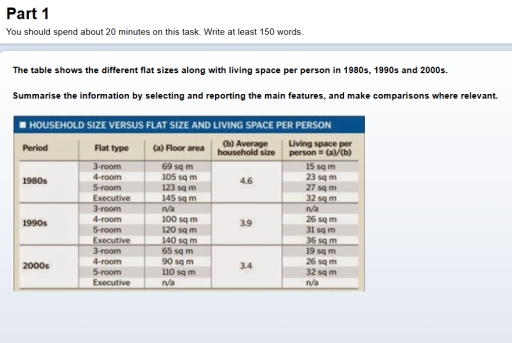
The image displays a table detailing household size versus flat size and living space per person across the 1980s, 1990s, and 2000s. In the 1980s, 3-room flats are 60 sq m, 4-room 90 sq m, 5-room 120 sq m, and Executive 145 sq m, with average household size at 4.6; living space per person recorded is 13 sq m for 3-room, 20 sq m for 4-room, 26 sq m for 5-room, and 32 sq m for Executive. In the 1990s, 3-room flats are 70 sq m, 4-room 100 sq m, 5-room 130 sq m, and Executive 150 sq m, with average household size at 3.7; living space per person is 19 sq m for 3-room, 27 sq m for 4-room, 35 sq m for 5-room, and 41 sq m for Executive. In the 2000s, 3-room flats are 90 sq m, 4-room 110 sq m, 5-room 140 sq m, and no data for Executive, with average household size at 3.4; living space per person is 26 sq m for 3-room, 32 sq m for 4-room, and 41 sq m for 5-room.
Given the complexity of the image, the above description may not be entirely accurate.
Note: Both the topic and the answer were created by one of our users.

The given table depicts the various smooth sizes along with residing area per person in 1980s, 1990s, and 2000s.

Overall, floor areas saw slight changes, the average houshold size steadily decreased, resulting in increased living space per person over period.

In 1980s, the average houshold size was 4.6, leading to limited living space person such as just 15sq m in 3-room flats and 32sq m in executive flats. In the 1990s, houshold size dropped to 3.9, although some flat sizes were slightly smaller with 4-room flats offering 26 sq m and executive flats providing upto 36 sq m per person.

By the 2000s, the average houshold size further declined to 3.4. Despite reductions in floor area for certain flat types, such as 4-room flats shrinking to 90 sq m, the living space per person remained the same such as 5-room flats pffered 32 sq m per person, highliting how smaller households contributed to more personal space.

Word Count: 156

Answers On The Same Topic:

he table shows the different flat sizes along with living space per person in 1980s, 1990s and 2000s. Summarise the information by selecting and reporting the main features, and make comparisons where relevant.

The table illustrates the space required by one individual to live and the several appratment dimentions from 1980 to 2000. The figures are shown in meter squares. Overall, the highest household mean size was in the start of the period whereas, the smallest living area was in the lowest room flat type in the same […]

he table shows the different flat sizes along with living space per person in 1980s, 1990s and 2000s. Summarise the information by selecting and reporting the main features, and make comparisons where relevant.

The table chart (table) depicts various types of flat sizes with living space per person in three different decades (the 1980s, 1990s, and 2000s). It gives information about the floor area, average household size, and living space per person. Overall, the average household size has decreased (decreased) along the years (over the years). Some type […]

he table shows the different flat sizes along with living space per person in 1980s, 1990s and 2000s. Summarise the information by selecting and reporting the main features, and make comparisons where relevant.

The picture compares the apartment size and living place for each person between 1980 and 2000. Overall, it is easy to notice that by 2000, floor area and average household size are decreased, while living space per person is slightly increased. In 1980, average household size accounted for 4.6 in overall. For every flat type […]

he table shows the different flat sizes along with living space per person in 1980s, 1990s and 2000s. Summarise the information by selecting and reporting the main features, and make comparisons where relevant.

This table demonstrates the various household sizes along with living space per individual in 1980s, 1990s and 2000s. This essay will illustrates flat types, floor areas, the average house sizes and living space per person in periods during 1980s to 2000s. Overall, the household size had been happened a large of changing, espically, sectors such […]

he table shows the different flat sizes along with living space per person in 1980s, 1990s and 2000s. Summarise the information by selecting and reporting the main features, and make comparisons where relevant.

The table illustrates the floor area of various flat types, their average household size, and the living space available per person in Singapore during the 1980s, 1990s, and 2000s. Overall, while the size of flats generally increased over the decades, the average living space per individual gradually decreased. This trend is mainly attributed to the […]

See All

Other Topics:

The line graph below shows the percentage of students who passed their final exams in four different subjects from 2010 to 2020.

The table chart compares the percentage of students who passed in their annual exam in four different subject between 2010 to 2020. It is clear that the highest percentage of students who passed in math subject over the period. However, the percentage of students who passed in history and literature was lowest in the given […]

The table shows information about the number of people who took the seven most popular airline in the US in 1995 and 2005.

The table under our study shows a comparison between the number of passengers of the seven most popular airlines in the US in 1995 and 2005. The airlines in question are Delta Air Lines, SouthWest Airlines, Unites Ailrines, American Airlines, Alaska Airlines, Hawaiin Airlines and JetBlues Airways. The key findings we can deduct from this […]

The table provides vital data about the amount of fast food consumed in Melbourne from 2005 to the present time and predictions for the future

The table illustrates the amounts of five major types of fast food eaten in Melbourne in 2005, at present, and in 2035. The figures are measured in units. Overall, hamburgers and fried chicken are the two most popular kinds of fast food in Melbourne during the whole period. The consumption of salads increases significantly and […]

The line graph below shows the percentage of households with access to the Internet in three countries - Nepal, India, and Japan - between 2000 and 2020. Summarize the information by selecting and reporting the main features, and make comparisons where relevant.

The line graph shows the percentage of households with access to the Internet in Nepal, India, and Japan from 2000 to 2020. Overall, Internet access increased significantly in all three countries during the period. Japan had the highest percentage throughout, while Nepal had the lowest. However, Nepal experienced the largest relative increase. In 2000, only […]

The table provides information about household budgets in a European country from 1920 to 1980. Provide an overview of the information by identifying and describing the key details, and include comparisons where appropriate.

The given table compares the percentage of household budgets spent on six different categories in a European country over the period of 60 years, starting from 1920. Overall, while the outlay for food and clothing fell considerably, that for transportation, housing and other demands registered a general increase with housing accounted for the largest share […]

The table below shows the average weekly salaries of men and of women working in different occupations. Summarize the information by selecting and reporting the main features and make comparisons where relevant.

The provided table delineates the average weekly earnings of men and women across five occupational categories – technicians, service workers, professionals, administrative/clerical workers, and manual laborers – for the year 2015. A salient observation is that men consistently outearned women in every occupation. Notably, professionals commanded the highest weekly salaries for both genders, whereas manual […]

See All
We have detected unusual activity on your device.
Please verify your identity to continue.
Note: This verification step won't sign you in. If you have a premium account, please log in to access the service as usual.
Google/Gmail Verification
Or verify using Email/Code
We've sent a verification code to:
youremail@gmail.com (Not your email?)
Enter it below to complete the verification process.
Ensure your email address is correct, your inbox is not full, and you check your spam folder. If no email arrives, consider using an alternative email.
You will need a Premium plan to perform your action!
Note: If you already have a premium account, please log in to access our services as usual.

Plans & Pricing

Our mission is to make quality education accessible for everyone.
However, to keep our hardworking team running and this service alive, we genuinely need your support!
By opting for a premium plan, not only do you sustain us in achieving the mission, but you also unlock advanced features to enrich your learning experience.

Free

For learners who aren't pressed for time

What's included on Free
100+ Cambridge IELTS Tests
Instant IELTS Writing Task 1 & 2 Evaluation (2 times/month)
Instant IELTS Speaking Part 1, 2, & 3 Evaluation (2 times/month)
Instant IELTS Writing Task 1 & 2 Essay Generator (2 times/month)
500+ Dictation & Shadowing Exercises
100+ Pronunciation Exercises
Flashcards
Other Advanced Tools

Premium

For those serious about advancing their English proficiency, and for IELTS candidates aspiring to boost their band score by 1-2 points (especially in writing & speaking) in just 30 days or less

What's included on Premium
Save Your IELTS Test Progress & Analyze Mistakes By Question Type
Save Your Own Flashcard Sets & Use Them On Any Device
Unlock All Courses, IELTS Tests, Section & Part Practice
Unlimited AI Conversations
Unlimited AI Writing Enhancement Exercises
Unlimited IELTS Writing Task 1 & 2 Evaluation
Unlimited IELTS Speaking Part 1, 2, & 3 Evaluation
Checked Answers Will Not Be Published
Unlimited IELTS Writing Task 1 & 2 Essay Generator
Unlimited IELTS Speaking Part 1, 2, & 3 Sample Generator
Unlimited Usage Of Advanced Tools & AI Features
Priority Support within 24h (12-month plan only)

Due to the nature of our service and the provided free trials, payments are non-refundable.