Our system will evaluate the answer based on this AI-generated description.
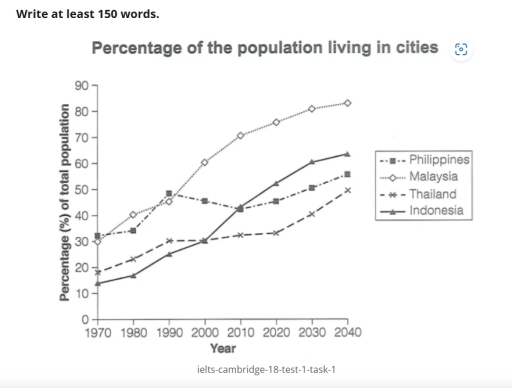
The image displays the urban population percentage from 1970 to 2040 for four countries: Philippines, Malaysia, Thailand, and Indonesia. In 1970, the Philippines had about 30%, Malaysia 25%, Thailand 15%, and Indonesia 10%. By 1980, the Philippines reached approximately 35%, Malaysia 35%, Thailand 20%, and Indonesia 15%. By 1990, the Philippines climbed to about 44%, Malaysia held steady around 45%, Thailand about 25%, and Indonesia around 25%. In 2000, Malaysia peaked at approximately 55%, Philippines 48%, Thailand 30%, and Indonesia 30%. By 2010, Malaysia reached roughly 63%, Philippines around 50%, Thailand 34%, and Indonesia 40%. In 2020, Malaysia's figure was around 70%, Philippines 53%, Thailand 38%, and Indonesia 50%. The projection for 2030 suggests Malaysia will be at about 75%, the Philippines at 58%, Thailand at 42%, and Indonesia at 55%. By 2040, Malaysia is expected to be at approximately 80%, Philippines 63%, Thailand about 46%, and Indonesia about 60%.
Given the complexity of the image, the above description may not be entirely accurate.
Skyrocket your IELTS band score by 1-2 points in under a month with our premium plan!
Note: Both the topic and the answer were created by one of our users.
Overall, urbanisation increased in all four countries over the period. In addition, one country had the highest urban population throughout, while another remained the least urbanised despite steady growth.
In 1970, around 30% of the population in Country A lived in cities, compared to about 20% in Country B. Both countries experienced gradual growth over time. By 2020, the urban population in Country A had risen significantly to approximately 60%, while Country B reached nearly 50%. It is predicted that these figures will continue to increase, reaching around 70% and 65% respectively by 2040.
In contrast, Country C and Country D had lower levels of urbanisation in 1970, at roughly 10% and 15% respectively. Although both showed consistent growth, their increases were slower. By 2020, Country C rose to about 40%, whereas Country D reached just over 35%. Future projections indicate that both will continue to grow, with figures expected to exceed 50% by 2040.
Word Count: 155
