Our system will evaluate the answer based on this AI-generated description.
The image displays a bar chart with European Health Expenditure as a Percentage of GDP (Gross Domestic Product) for the years 2002, 2007, and 2012. Belgium's health expenditure percentages are 7.9 (2002), 10.3 (2007), and 10.7 (2012); Denmark's are 8.4 (2002), 9.5 (2007), and 10.4 (2012); Estonia's are 5.0 (2002), 5.7 (2007), and 6.2 (2012); France's are 10.1 (2002), 11.2 (2007), and 11.6 (2012); Lithuania's are 5.6 (2002), 6.2 (2007), and 6.8 (2012); Luxembourg's are 5.9 (2002), 7.1 (2007), and 7.2 (2012); Netherlands' are 8.7 (2002), 9.4 (2007), and 11.9 (2012); Norway's are 7.8 (2002), 8.2 (2007), and 9.3 (2012); Poland's are 4.3 (2002), 6.4 (2007), and 6.6 (2012); Slovenia's are 6.6 (2002), 7.7 (2007), and 8.4 (2012); Spain's are 6.7 (2002), 8.5 (2007), and 9.1 (2012); Switzerland's are 10.4 (2002), 10.7 (2007), and 11.4 (2012).
Given the complexity of the image, the above description may not be entirely accurate.
Skyrocket your IELTS band score by 1-2 points in under a month with our premium plan!
Note: Both the topic and the answer were created by one of our users.
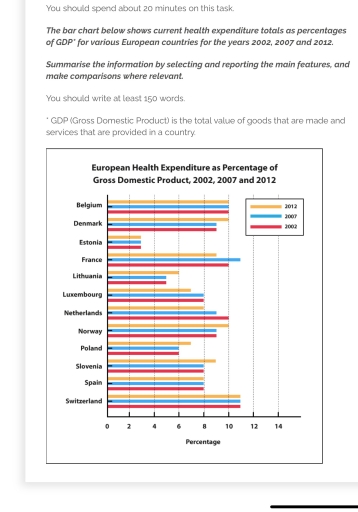
The provided bar chart delineates the total percentage of spending on healthcare by twelve European states in 2002,2007, and 2012 utilizing the Gross Domestic Product measure.
Overall, Switzerland demonstrated the highest proportion over the period, while in contrast, the lowest belonged to Estonia.
To begin with, as it was mentioned before, the Swiss dominated the whole period, illustrating a stable index of approximately 11%. Following this, Belgium, Spain, and Estonia showed the same pattern of regularity throughout the time, 10%, 8% and about 3% respectively. In addition, four countries were stable in the first two years and faced a slight increase in 2012. Precisely, in Norway and Denmark (9% in 02′, 07′ and 10% in 2012), in Slovenia, the number grew from 8% to 9, in Poland (from 6 to 7 percent), and in Lithuania, it rose from 5 to 6 percent. On the contrary, there was an insignificant decrease in the Netherlands (10% in 2002 and 8% in 2012) and Luxembourg’s (8% to 7%) ranks. Finally, only France illustrated noticeable fluctuations over time.
Word Count: 174
