Our system will evaluate the answer based on this AI-generated description.
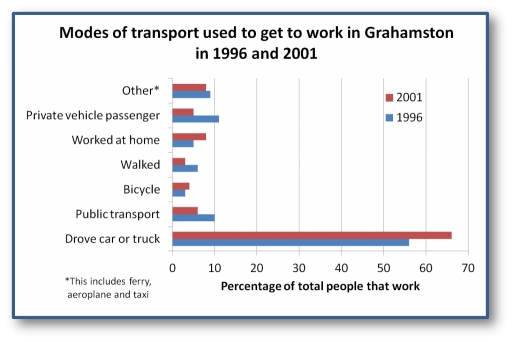
The image depicts a bar chart showing the percentage of total people that work in Grahamston using different modes of transport in 1996 and 2001, with a footnote mentioning that "Other*" includes ferry, aeroplane, and taxi. The x-axis measures from 0 to 70 in increments of 10 percentage points, and the y-axis lists modes of transport in descending order as follows: Drove car or truck, Public transport, Bicycle, Walked, Worked at home, Private vehicle passenger, and Other*. For 1996, the percentages are approximately: Drove car or truck 60%, Public transport 50%, Bicycle 20%, Walked 10%, Worked at home 5%, Private vehicle passenger 15%, Other* 5%. For 2001, the percentages are approximately: Drove car or truck 65%, Public transport 40%, Bicycle 13%, Walked 20%, Worked at home 8%, Private vehicle passenger 12%, Other* 3%. The bars are depicted in pairs for each mode of transport, with one bar representing 1996 and one bar representing 2001.
Given the complexity of the image, the above description may not be entirely accurate.
Skyrocket your IELTS band score by 1-2 points in under a month with our premium plan!
Note: Both the topic and the answer were created by one of our users.
The chart below illustrates the means of transportation people used to commute to work in the years 1996 and 2001 in Grahamston. There are 7 modes of transportation to choose from: driving a car or truck, being a passenger in a private vehicle, walking, cycling, using public transport, and others (including taxis, ferries, and airplanes).
Firstly, the most preferred mode of transportation was by car or truck, with around 77% usage in 2001. In contrast, the usage was slightly lower in 1996 at 56%, still the highest for that year.
Secondly, there was a significant 11% difference in the use of private vehicle passengers between 1996 and 2001. The remaining modes each accounted for 10% or less in both years. In 1996, the usage of ‘other’ or public transport was similar at 9% and 10% respectively. Walking and walking at home constituted 6% and 5% in 1996 and remained the same in 2001. Cycling was the least popular mode of transportation in 1996.
Word Count: 163
