Our system will evaluate the answer based on this AI-generated description.
The image presents a bar graph showing spending on international tourism in billion dollars for seven countries in 2011 and 2012. The vertical axis, labeled as spending in billion dollars, has increments of 20 from 0 to 120, while the horizontal axis lists the countries. For China, the spending depicted for 2011 is about 73 billion dollars, while for 2012 it is around 100 billion dollars. Germany's spending for 2011 is approximately 84 billion dollars and for 2012 about 83 billion dollars. The United States' spending in 2011 is roughly 79 billion dollars, and in 2012 it is close to 83 billion dollars. The United Kingdom's spending in 2011 is around 51 billion dollars and in 2012 approximately 52 billion dollars. The Russian Federation shows a spending of about 43 billion dollars in 2011 and nearly 50 billion dollars in 2012. France's spending in 2011 is close to 38 billion dollars while in 2012 it is approximately 37 billion dollars. Finally, Canada's spending is depicted at around 24 billion dollars for both 2011 and 2012.
Given the complexity of the image, the above description may not be entirely accurate.
Skyrocket your IELTS band score by 1-2 points in under a month with our premium plan!
Note: Both the topic and the answer were created by one of our users.
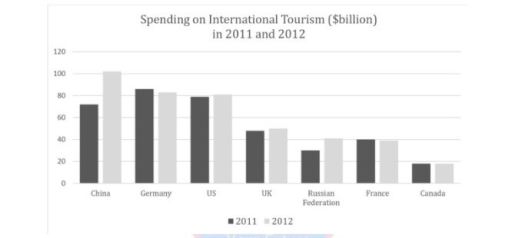
The bar chart compares the international tourism expenditure of residents from seven countries in 2011 and 2012. Overall, China experienced an extraordinary rise and became the leading spender by 2012, while Canada consistently recorded the lowest figures.
In 2011, Germany topped the list at $85 billion, followed by the United States at $79 billion and China at $72 billion. By 2012, China’s spending soared to $102 billion, surpassing both Germany, which fell slightly to $83 billion, and the US, which increased modestly to $81 billion.
Among the remaining countries, the UK’s expenditure saw only a marginal increase from $49 to $50 billion. France was the only country, apart from Germany, to register a decline, slipping from $40 billion to $39 billion. Russia, in contrast, showed significant growth, rising from $30 billion to $41 billion, nearly catching up with France and the UK. Canada remained the lowest throughout the period, spending just $19 billion in both years.
In summary, while most countries experienced little change, China’s rapid growth and subsequent dominance in international tourism spending were the most notable features.
Word Count: 179
