Our system will evaluate the answer based on this AI-generated description.
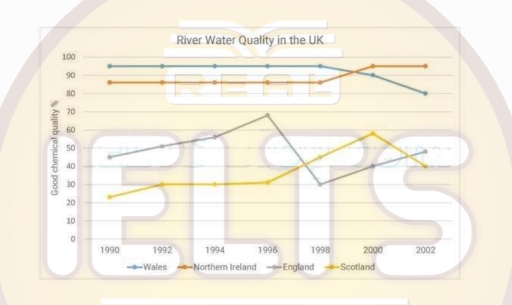
The image displays a line graph titled "River Water Quality in the UK" tracking data from 1990 to 2002 for Wales, Northern Ireland, England, and Scotland. The y-axis ranges from 0 to 100%, marked at intervals of 10, and represents "Good chemical quality %". Data for each region shows: Wales starting near 95% in 1990, peaking just below 100% around 1994, dipping slightly in 1996, and stabilizing near 95% in 2002. Northern Ireland begins around 60% in 1990, shows a sharp improvement to nearly 90% by 1994, sees a sharp drop back to 60% in 1996, recovers to around 90% by 1998 and 2000, dropping sharply again by 2002. England starts just above 70% in 1990, dips slightly below during the mid-90s, and climbs back to just above 70% by 2002. Scotland begins just under 90% in 1990, experiences a gradual decrease to about 80% by 2002. The graph uses distinct line styles for each region, plotted on a horizontally-oriented rectangular plot area with a grid.
Given the complexity of the image, the above description may not be entirely accurate.
Skyrocket your IELTS band score by 1-2 points in under a month with our premium plan!
Note: Both the topic and the answer were created by one of our users.
The line chart illustrates the proportion of four different rivers which have a good quality water in the UK from 1990 to 2002.
Overall, all rivers quality were over 80% and showed an upward trend during the period, excepting the Wales. the Scotland became the best quality of river by 2002, while the worst quality of it was the England throughout the period.
In 1990, the Wales was the best river quality (97%) and maintain the same level before it was surpassed by the Scotland by 1999, reaching at 96%, meanwhile, the percentage of river quality decreased continually to 94% by 2002. However, the figure for river quality in the Scotland increased from 95% in 1990 to 98% in 2002, becoming the best.
The water quality in the Northern Ireland experienced a fluctuation throughout the timeframe. The percentage of it fluctuated between 1990 and 1996, which declined from 93% to 84% and returned to 95.5% and decreased to 82% again, while the figure for it rose consistently, peaking the highest point of 95%, with the same percentage with the Scotland. In contrast, the British reiver remained steady before shaped rapidly, increasing from 82% to 91% by 2002.
Word Count: 197
