Our system will evaluate the answer based on this AI-generated description.
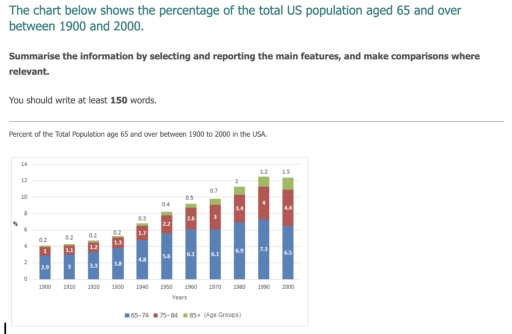
The image is a bar chart with eight bars, representing the percentage of the total US population aged 65 and over between 1900 and 2000, at ten-year intervals. Among all bars, three age groups are represented by segmented colors in each bar: 65-74, 75-84, and 85+. In 1900, 65-74 was 3.1%, 75-84 was 0.2%, and 85+ was 0.01%. In 1910, 65-74 was 3.2%, 75-84 was 0.3%, and 85+ was 0.02%. In 1920, 65-74 was 3.5%, 75-84 was 0.4%, and 85+ was 0.02%. In 1930, 65-74 was 4.1%, 75-84 was 0.6%, and 85+ was 0.03%. In 1940, 65-74 was 4.5%, 75-84 was 0.7%, and 85+ was 0.04%. In 1950, 65-74 was 5.0%, 75-84 was 1.0%, and 85+ was 0.07%. In 1960, 65-74 was 6.0%, 75-84 was 1.4%, and 85+ was 0.1%. In 1970, 65-74 was 7.1%, 75-84 was 2.0%, and 85+ was 0.2%. In 1980, 65-74 was 8.3%, 75-84 was 2.7%, and 85+ was 0.4%. In 1990, 65-74 was 9.6%, 75-84 was 3.4%, and 85+ was 0.7%. In 2000, 65-74 was 10.1%, 75-84 was 3.5%, and 85+ was 1.2%. Overall, the trend shows an increase in the percentage of the population aged 65 and over, with significant growth in the older age groups, especially 85+.
Given the complexity of the image, the above description may not be entirely accurate.
Skyrocket your IELTS band score by 1-2 points in under a month with our premium plan!
Note: Both the topic and the answer were created by one of our users.
The provided bar chart depicts the changes in the percentage of the elderly population aged 65 and above in the United States over the span of a century from 1900 to 2000.
Overall, there was a consistent upward trajectory in the proportion of older individuals in the US over the specified period. The 65-74 age category consistently represented the majority, with the 75-84 age group following, and the 85 and above age category consistently showing the lowest percentage.
Initially in 1900, the elderly population made up 4% of the total US population, with 2.9% being aged 65-74, 1% aged 75-84, and merely 0.2% aged 85 and above. By 1940, this percentage had more than doubled to over 8%, with significant increases in all three age groups, notably 5.6% for 65-74 years old. The trend continued with a steady increase, reaching its peak at around 12.5% in 1990.
Between 1960 and 2000, the proportion of seniors showed sustained growth, culminating in over 12% by the end of the period. By 2000, the percentage dropped slightly but remained considerable. While the percentage of the 65-74 age group declined to 6.5% by 2000, both the 75-84 and 85 and above age groups exhibited an upward trend, reaching 4.4% and 1.5% respectively.
Word Count: 208
