Our system will evaluate the answer based on this AI-generated description.
The image is a bar graph and a table depicting export earnings from 2015 to 2016. The bar graph shows 5 product categories: Petroleum products, Engineered goods, Gems and jewellery, Agricultural products, and Textiles. For 2015 and 2016, Petroleum products earn approximately $60 billion and $58 billion respectively, Engineered goods earn approximately $50 billion and $54 billion respectively, Gems and jewellery earn about $42 billion and $38 billion respectively, Agricultural products earn roughly $22 billion and $22 billion respectively, and Textiles earn around $18 billion and $20 billion respectively. The table below the bar graph shows the percentage change in values from 2015 to 2016 for each category: a 3% decrease for Petroleum products, an 8.5% increase for Engineered goods, a 5.18% decrease for Gems and jewellery, a 0.81% increase for Agricultural products, and a 15.24% increase for Textiles.
Given the complexity of the image, the above description may not be entirely accurate.
Skyrocket your IELTS band score by 1-2 points in under a month with our premium plan!
Note: Both the topic and the answer were created by one of our users.
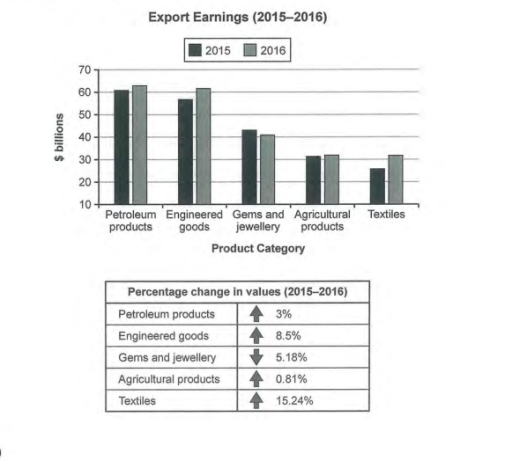
The provided graphs illustrate the proportion of export income by petroleum products, engineered goods, gems and jewellery, agriculture products, and textiles in both 2015 and 2016.
Overall, there was a slight increase for all categories from 2015 to 2016, except gems and jewellery. They fell from 42 per cent to a low of approximately 40 per cent in 2016. In contrast, Textiles grew significantly about 15.24 per cent to over 30 per cent in 2016; as a result, they become the highest proportion of growth, in that order. In the second place, engineering goods grew 8.5 per cent, followed by petroleum products 3 per cent, and agricultural products 0.81 per cent.
Notably, even though, textiles were the highest percentage of growth, they were the lowest number of earnings among the five types. Their percentage were just about 30 per cent, while petroleum products, the highest, reached a peak of approximately 62 per cent by 2016.
Word Count: 155
