Our system will evaluate the answer based on this AI-generated description.
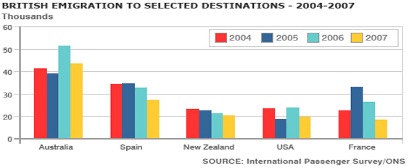
The image depicts a bar graph illustrating British emigration to selected destinations between 2004-2007, with thousands on the y-axis and destination countries on the x-axis. Each country has four bars representing the years, with blue for 2004, red for 2005, green for 2006, and yellow for 2007. Australia had the highest emigration numbers, starting around 50,000 in 2004, decreasing steadily each year to just over 30,000 in 2007. Spain's numbers ranged from just over 40,000 in 2004 to around 35,000 in 2007. New Zealand saw a consistent decrease from just over 20,000 in 2004 to around 10,000 in 2007. The USA had an increase from 20,000 in 2004 to nearly 30,000 in 2006 before dropping to around 20,000 in 2007. France's numbers remained relatively stable, starting at just over 10,000 in 2004, peaking at around 15,000 in 2005, and settling at just under 10,000 in 2007. The data source is the International Passenger Survey/ONS.
Given the complexity of the image, the above description may not be entirely accurate.
Skyrocket your IELTS band score by 1-2 points in under a month with our premium plan!
Note: Both the topic and the answer were created by one of our users.
The bar chart illustrates the British migration to chosen lands from the years 2004 to 2007. Overall, Australia has the highest rate compared to other countries, with Spain following closely. On the other hand, New Zealand, the USA, and France are the countries with the least emigration.
The emigration of British people started above 40% and decreased by 1% in 2004 and 2005, respectively. In 2007, it suddenly dropped to 5% after reaching its peak of 14% in 2006. In contrast, France had a low of 25% initially, then surged to 20% before declining to the lowest point of 19%.
Spain, the second highest after Australia, maintained percentages of 44 and 45 for the years 2004 and 2005, then dropped to 35% in 2007 after a slight decrease from the previous measurement. The USA and New Zealand remained below 30% on the chart with minimal fluctuation. New Zealand saw a reduction to 2% each year, eventually reaching 2%. In contrast, the USA was 1% higher than New Zealand in 2004 and also in 2006, but subsequently decreased to the same level as New Zealand.
Word Count: 184
Word Count: 187
