Our system will evaluate the answer based on this AI-generated description.
The image contains two pie charts comparing the number of men and women in full-time and part-time employment in the UK in 1988 and 2012 respectively. In 1988, there were a total of 23,180 individuals employed, with men in full-time work accounting for the majority at 12,650, followed by women in full-time work at 4,899, men in part-time work at 1,298, and women in part-time work at 4,332. In 2012, the total employed individuals increased to 25,259 with men in full-time work slightly reduced to 12,566, women in full-time work increased to 7,246, men in part-time work increased to 2,374, and women in part-time work increased to 3,073. The data demonstrates that over the 24 year period, there was a decrease in the proportion of men in full-time employment and an increase in all other categories, with a significant rise in the number of women in full-time employment.
Given the complexity of the image, the above description may not be entirely accurate.
Skyrocket your IELTS band score by 1-2 points in under a month with our premium plan!
Note: Both the topic and the answer were created by one of our users.
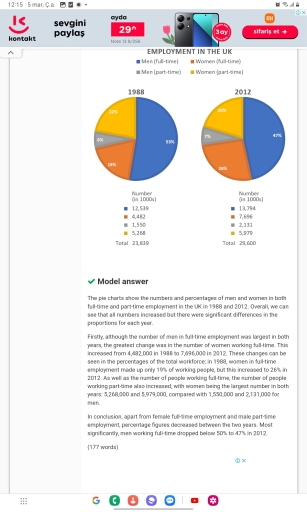
The chart documents the employments rate of different genders in the UK in 1998 and 2012.
Overall, the chart consists of 4 major sections which are related to men and women where men(full-time) have largest proportion in the chart, also the total number of workers have been increase.
Men(full-time) consist more than half of the cart with 53% and 12539 people and in 2012 the volume of men(full-time) increased to 13794 while its percentage decreased to 47% because of a grow in total number of employment people. After that, women(part-time) had the second most percentage with 22% and 5268 folks which increased slightly to 5979 buddies also, its proportion fall down to 20%.
As well as this, women(full-time) had the third rank with 19% in 1998 and 4482 folks that, raised dramatically and got almost doubled (7696) which have second highest proportion with 26%. Finally, men(part-time) had the lowest percentage in both years with 6 and 7% where it had 1550 and 2131 employee in order.
Word Count: 166
