Our system will evaluate the answer based on this AI-generated description.
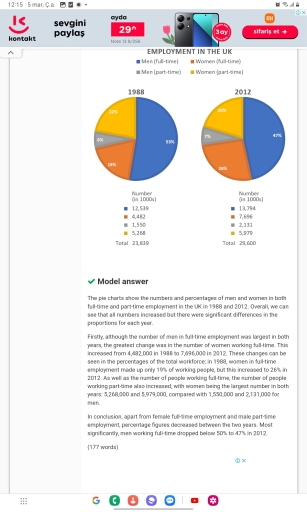
The image contains two pie charts comparing the number of men and women in full-time and part-time employment in the UK in 1988 and 2012 respectively. In 1988, there were a total of 23,180 individuals employed, with men in full-time work accounting for the majority at 12,650, followed by women in full-time work at 4,899, men in part-time work at 1,298, and women in part-time work at 4,332. In 2012, the total employed individuals increased to 25,259 with men in full-time work slightly reduced to 12,566, women in full-time work increased to 7,246, men in part-time work increased to 2,374, and women in part-time work increased to 3,073. The data demonstrates that over the 24 year period, there was a decrease in the proportion of men in full-time employment and an increase in all other categories, with a significant rise in the number of women in full-time employment.
Given the complexity of the image, the above description may not be entirely accurate.
Skyrocket your IELTS band score by 1-2 points in under a month with our premium plan!
Note: Both the topic and the answer were created by one of our users.
The pie charts illustrate the percentages of men and women in both full-time and part-time employment in the UK in 1988 and 2012.
Overall, it is obvious that the data indicates that the total number of individuals employed by companies or organizations in the UK was higher in 2012 compared to 1988. Additionally, the number of men working both part-time and full-time exceeded that of women in both years.
In detail, the graphs reveal that the proportion of males employed full-time has remained steady at around 50%, except for a slight decrease from 53% to 47%. The opposite was true for males employed part -time, the number of men working part-time was the lowest in both years, recorded at 1,550 and 2,131, representing less than 10% of the total survey participants.
By contrast, the total number of full-time female employees increased significantly from 4,482 to 7,696, more than doubling. Whereas the total number of women working part-time was considered to have decreased marginally.
Word Count: 163
