Our system will evaluate the answer based on this AI-generated description.
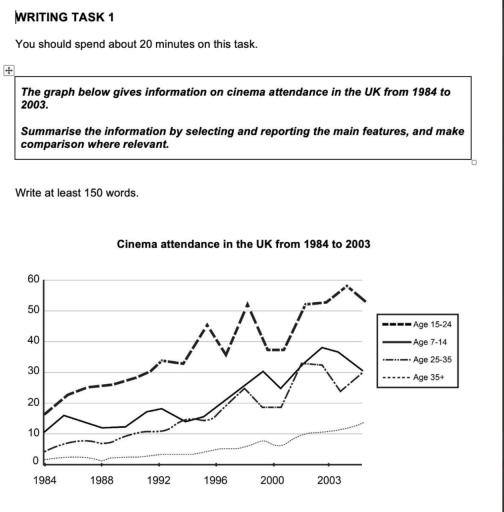
The image displays a line graph, 'Cinema attendance in the UK from 1984 to 2003', showing data for four age groups across a vertical axis from 0 to 60. For the Age 15-24 group, the approximate yearly values are: 16 (1984), 22 (1985), 24 (1986), 25 (1987), 26 (1988), 28 (1989), 29 (1990), 32 (1991), 33 (1992), 32 (1993), 40 (1994), 45 (1995), 35 (1996), 46 (1997), 52 (1998), 40 (1999), 38 (2000), 45 (2001), 52 (2002), and 57 (2003). For the Age 7-14 group, the approximate values are: 10 (1984), 16 (1985), 15 (1986), 12 (1987), 12 (1988), 11 (1989), 17 (1990), 18 (1991), 12 (1992), 12 (1993), 15 (1994), 15 (1995), 20 (1996), 25 (1997), 27 (1998), 30 (1999), 25 (2000), 32 (2001), 38 (2002), and 30 (2003). For the Age 25-35 group, the values are approximately: 7 (1984), 5 (1985), 6 (1986), 8 (1987), 7 (1988), 7 (1989), 9 (1990), 11 (1991), 18 (1992), 12 (1993), 13 (1994), 13 (1995), 15 (1996), 22 (1997), 26 (1998), 18 (1999), 19 (2000), 30 (2001), 32 (2002), and 22 (2003). For the Age 35+ group, the approximate values are: 3 (1984), 1 (1985), 1 (1986), 2 (1987), 0 (1988), 1 (1989), 2 (1990), 2 (1991), 3 (1992), 2 (1993), 3 (1994), 4 (1995), 4 (1996), 5 (1997), 4 (1998), 8 (1999), 6 (2000), 8 (2001), 10 (2002), and 13 (2003).
Given the complexity of the image, the above description may not be entirely accurate.
Skyrocket your IELTS band score by 1-2 points in under a month with our premium plan!
Note: Both the topic and the answer were created by one of our users.
The graph provided, represents cinema attendance in the UK, spanning almost two decades, from 1984 to 2003.
People aged from 15-24 remained the highest attendees throughout the years, compared to the other age groups. Their attendance grew steadily, with a sudden drop around the late 90s, which was then followed by an immediate rebounce, and yet another decline in the early 2000s, which reached a plateau for a couple of years before it started increasing again.
The age group that directly followed were kids and preteens, with their attendance showing an overall increase over the years, with less dramatic flunctuations.
Young adults ranged from 25 to 35 years old, demonstrated a steady increase for over a decade, before a gradual decline in the late 90s that plateaued until the early 2000s, when it gradually skyrocketed.
Overall, adults over the age of 35 consistently held the lowest attendance rate out of all the age groups. Up until the year 2000 attendance remained constant, with only a more noticeable increase happening near the year 2003.
Word Count: 173
