Our system will evaluate the answer based on this AI-generated description.
The image shows data trends from 1962 to 2012 for Services, Manufacturing, Agriculture, Construction, and Mining; in 1962, Services at 40%, Manufacturing at 25%, Agriculture at 30%, Construction at approximately 3%, and Mining at 2%; in 1972, Services at 50%, Manufacturing at approximately 21%, Agriculture at 25%, Construction at 2%, and Mining at around 2%; in 1982, Services at 55%, Manufacturing at approximately 15%, Agriculture at 19%, Construction at 2%, and Mining at around 1%; in 1992, Services at 60%, Manufacturing at around 10%, Agriculture at 14%, Construction at approximately 2%, and Mining at around 1%; in 2002, Services at 70%, Manufacturing at approximately 7%, Agriculture at 11%, Construction at 2%, and Mining at less than 1%; in 2012, Services at around 78%, Manufacturing at 6%, Agriculture at 9%, Construction at around 2%, and Mining at less than 1%.
Given the complexity of the image, the above description may not be entirely accurate.
Skyrocket your IELTS band score by 1-2 points in under a month with our premium plan!
Note: Both the topic and the answer were created by one of our users.
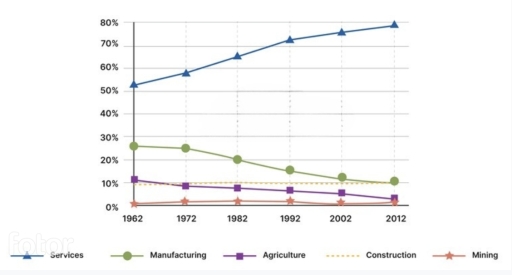
The line graph illustrates how the proportion of the Australian workforce in five distinct sectors changed over a 50-year period since 1962.
Overall, all the rankings of these categories remained unaltered throughout the reported period, with services maintaining its top position and mining languishing at the opposite end. Additionally, services was the only sector that experienced an upward trend.
In 1962, services led the chart, registering more than 50%. There was a marked disparity between this category and manufacturing, which ranked second, with the figure for the former being double that of the latter. Compared to these two sectors, agriculture and mining registered a substantially lower statistics in the beginning, with just over 10% and 1%, respectively.
Afterwards, only services witnessed a considerable growth, continuously rising and ending the period with nearly 80%. By contrast, manufacturing and agriculture showed a fairly similar downward trend, both dropping to approximately 10% and 2% in 2012, respectively. Turning to mining, the data for this category experienced negligible fluctuations, thereby plateauing at roughly 1% during the examined period.
Word Count: 174
